How to Receive Money from Abroad in Nigeria with CoinCola

If someone abroad is sending you money for rent, school fees or everyday expenses, you need to know two things: how to receive it, and how much Naira you can actually use.
With CoinCola, one route is to receive USDT in your wallet and then sell it for Naira through the P2P marketplace. The overseas transfer and the local payment are separate steps: your sender transfers USDT, and a P2P buyer pays you NGN when you sell it.
Quick answer: How can you receive money from abroad in Nigeria?
To receive money from abroad in Nigeria with CoinCola, set up your account, complete the required verification, share your supported USDT deposit details with the sender, and wait for the funds to become available. Then sell USDT through an NGN P2P offer and confirm the Naira payment before releasing your crypto.
This is a crypto-to-Naira route. Receiving USDT does not automatically credit your Nigerian bank account. CoinCola’s USDT-to-Naira marketplace provides the selling stage.
Create your CoinCola account using the Sign Up option, or check USDT-to-Naira offers before your sender transfers funds.
What do you and your sender need?
Agree on the receiving method before anyone buys or sends crypto.
| You, in Nigeria | Your sender abroad |
|---|---|
| A CoinCola account with the verification required for your intended activity | Access to USDT through a service available to them |
| Current USDT deposit details from your account | A withdrawal option matching your selected receiving network |
| A supported Naira payment account that meets platform and offer requirements | Enough funds to cover buying and sending costs |
| An NGN offer suitable for your amount and payment method | Confirmation of the USDT amount you should receive after any deductions |
Check account eligibility, verification and current restrictions before funding the transfer. For this walkthrough, choose an offer that pays your own supported bank account. Naira Balance offers follow a different payment route; check their terms and withdrawal requirements separately.
How to receive USDT and convert it to Naira
1. Set up your CoinCola account
Register through the official website or app. Complete the identity checks shown in your account and secure your login before sharing deposit details.
Keep your password and verification codes private. Your sender needs the receiving details, not access to your account.
2. Get your current USDT deposit details
Open your wallet, select USDT and choose the deposit option. Follow the instructions displayed for the receiving network, address and any additional required information. See CoinCola’s deposit guide.
The sender’s withdrawal network must match the network selected for your CoinCola deposit. Do not assume that every network supporting USDT is supported by your account.
Copy the address from your current deposit screen and confirm it with your sender. Incorrect transfer information can cause asset loss; recovery should never be assumed. CoinCola explains these situations in its incorrect deposit and withdrawal information guide.
If you decide to make a small test transfer, first check the deposit minimum and sending fee. A test below the minimum may not be credited.
3. Wait for the USDT to become available
Ask your sender for the transaction reference if needed. Check your CoinCola deposit history and available balance before starting the sale. A sender’s screenshot alone does not establish that your deposit is ready to use.
Published deposit data: CoinCola’s help centre lists a 1 USDT minimum deposit and 0 USDT deposit fee for both USDT-TRC20 and USDT-ERC20. These are deposit conditions, not the minimum amount you can sell through P2P. Check your deposit screen for current requirements. Source: CoinCola deposit and transfer schedule.
Your sender can also consult our guides for sending USDT from the USA or sending money from Canada to Nigeria. They should confirm current service availability and applicable requirements in their location.
4. Compare offers before selling
Select Sell, USDT and NGN in the P2P market. Review suitable offers rather than choosing on price alone.
Check the buyer’s trading record, payment method, amount limits and terms. Confirm that the order preview shows the amount of USDT you intend to sell and the Naira payment you expect. If your funds are held in another wallet section, follow the account instructions to make them available for P2P trading.
Ask any questions in the order chat before proceeding. Avoid arrangements that move the transaction outside the platform.
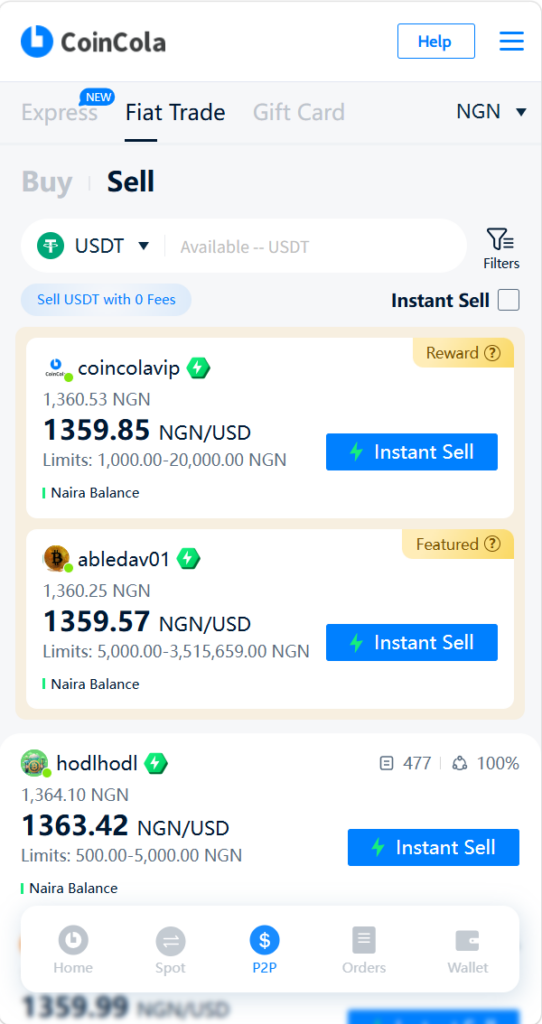
View current USDT-to-Naira offers.
5. Check your Naira payment before releasing USDT
Follow the order instructions to provide your permitted receiving details. For a bank-transfer order, independently check your bank account for the full agreed payment.
Release USDT only after confirming the payment in your own account. A payment message, screenshot or notification is not a substitute for checking the credit. CoinCola’s P2P selling guide describes checking the bank balance before release.
Escrow holds the crypto during the trade; it does not guarantee that a payment claim is genuine or remove every transaction risk. If the buyer marks an order paid but the funds have not arrived, keep the crypto unreleased and use the order’s support or dispute process. Retain the order number and relevant records.
How much Naira will you receive?
The Naira amount from a USDT sale depends on the USDT available to sell and the rate agreed in the P2P order. A dollar exchange-rate search does not establish your executable USDT-to-Naira quote.
For a simple order quoted in NGN per USDT:
Gross NGN payment = USDT sold × agreed NGN price per USDT.
Then account for any applicable recipient-side deductions. Use the confirmed order amount and actual payment to establish the final result.
Calculation example: 300 USDT
The figures below are hypothetical calculations, not current quotes or promised returns. They assume 300 USDT is available to sell and no additional recipient-side deduction.
| Illustrative order price | USDT sold | Gross Naira payment |
|---|---|---|
| ₦1,300 per USDT | 300 | ₦390,000 |
| ₦1,350 per USDT | 300 | ₦405,000 |
| ₦1,400 per USDT | 300 | ₦420,000 |
In this example, a ₦50 difference per USDT changes the gross payment by ₦15,000 on a 300 USDT sale. That is why the final Naira amount matters as much as the advertised fee.
If your sender starts with a $300 budget, do not assume you will receive 300 USDT. Buying prices and sending fees can reduce the USDT arriving in your wallet.
Why compare the full cost of receiving money?
The World Bank’s Remittance Prices Worldwide report for Q3 2025 reported an average cost of 6.36% globally and 8.46% for Sub-Saharan Africa for its standard small-remittance comparison. These are historical averages across surveyed services and corridors, not current Nigeria quotes or CoinCola prices.
| World Bank benchmark | Reference period | Reported average cost |
|---|---|---|
| Global remittances | Q3 2025 | 6.36% |
| Remittances to Sub-Saharan Africa | Q3 2025 | 8.46% |
Source: Remittance Prices Worldwide, Issue 54, September 2025, global average and regional cost tables. The report’s principal benchmark concerns sending $200 or the surveyed local-currency equivalent; its separate $500 analysis should not be mixed with these figures.
The World Bank’s remittance pricing methodology explains that exchange-rate margins can add costs beyond the visible transfer fee. Some receiving-side fees and taxes are not captured in its database. For your own transfer, compare what your sender pays with what you can actually receive after conversion and applicable charges.
A zero transfer fee does not establish the lowest total cost. Compare the final spendable Naira for the same sending budget, using quotes obtained at approximately the same time.
What fees should you check?
Using an existing CoinCola P2P advertisement to buy or sell crypto carries no platform trading fee under the published fee schedule. That does not mean the complete overseas-to-Naira journey is free.
Separate these costs:
| Cost | Where to check |
|---|---|
| Buying USDT with the sender’s currency | The sender’s purchase quote and payment-provider charges |
| Sending USDT | The originating wallet or exchange withdrawal screen |
| Receiving USDT | Your deposit screen and CoinCola’s deposit schedule |
| Selling for Naira | The NGN order quote, fee rules and trade terms |
| Any payment-account or withdrawal charges | The relevant provider’s terms |
CoinCola’s published fee page lists 2 USDT for USDT-TRC20 and USDT-ERC20 crypto withdrawals and a standard 0.7% advertiser trading fee, subject to applicable event terms. The withdrawal figure applies to withdrawals from CoinCola, not every sending platform. Fees can change; check the displayed charge before confirming. Source: CoinCola Fees.
For a broader comparison, read Cheapest Way to Send Money to Nigeria, and compare live quotes for the same sending budget.
How long does the complete process take?
There is no single guaranteed completion time for receiving USDT and converting it to Naira. The total includes sender preparation, transfer confirmation, platform crediting and the buyer’s local payment.
The World Bank’s methodology measures transfer speed by when the funds become available to the receiver. For this walkthrough, assess the full time until you have usable Naira, rather than timing only the USDT transfer.
The Financial Stability Board’s cross-border payments programme identifies cost, speed, access and transparency as four recurring challenges. Use those four questions when choosing your route: what will it cost, when will the money be usable, can both parties access the service, and are the conditions clear?
An on-chain confirmation does not mean that Naira has arrived. Network congestion, account checks, maintenance, buyer response and payment-provider processing may affect different stages.
If you need money for a deadline, allow time for the entire process. Avoid promising a landlord or school a payment time based only on the blockchain stage.
Is this receiving method right for you?
This route may suit you if your sender can obtain and send supported USDT, you can meet CoinCola’s account requirements, and you are comfortable reviewing and completing a P2P sale.
If you need cash pickup or a bank deposit without handling crypto, this walkthrough does not describe that service. Compare a receiving option that meets those needs.
USDT is designed to track the US dollar, according to Tether’s FAQ, but its market price can deviate from that target. It is a digital token, not a bank deposit. Issuer, custody, platform and counterparty risks remain; see Tether’s risk disclosures. Escrow does not insure your wallet balance or protect against sending to the wrong address.
The Bank for International Settlements’ 2025 analysis of stablecoins notes that their secondary-market prices can depart from the intended peg, and that lower costs or faster transfers are not assured in every case. For your transaction, compare executable quotes and keep both the transfer and conversion stages in view. This analysis concerns stablecoins generally; it is not an assessment or endorsement of CoinCola.
Frequently asked questions
Does the sender need a CoinCola account?
For an external deposit, the sender needs a permitted service capable of withdrawing supported USDT to your current CoinCola deposit details. Confirm that the originating platform and transaction are accepted before sending. Do not assume every platform or source is eligible.
Can I receive Naira directly instead of USDT?
In the route explained here, you receive USDT first and then sell it through an NGN offer. Receiving the token and receiving the local payment are separate events.
Is the minimum USDT deposit also the P2P selling minimum?
No. CoinCola’s published USDT deposit minimum is 1 USDT. P2P offers have their own amount limits, so you must also find an offer that accepts the amount you want to sell.
Can I use someone else’s bank account to receive payment?
Use your own supported account and follow current platform and offer requirements. Do not assume a third-party account is allowed. Ask official support if you are unsure before opening the order.
What if the sender used the wrong network?
Contact official CoinCola support with the transaction reference, asset, network and receiving address. Do not send another transfer to the same details while the issue remains unresolved. Recovery is not guaranteed.
What if a buyer says they paid but I have not received Naira?
Do not release USDT. Independently check your receiving account and use the order’s support or dispute channel if the full agreed payment is missing.
Get ready for your first payment
Before your family sends money, set up your account, check your deposit details and compare an NGN offer for the expected amount. Share the receiving instructions with your sender so both sides understand the process and costs.
Create your CoinCola account through Sign Up. Already have USDT available? View USDT-to-Naira offers and check the amount you could receive before starting an order.
Source note: Product figures in this guide were checked against CoinCola’s official help centre on 30 September 2026. They are published reference figures, not a live quote or account-specific guarantee. Current account instructions, order terms and displayed fees govern your transaction. All Naira figures in the calculation example are illustrative.