How to Buy Bitcoin in Ghana with MoMo (Mobile Money)

Yes, you can buy Bitcoin in Ghana with mobile money, and you do not need a bank account, a Visa card or a dollar account to do it. On CoinCola P2P you choose a vendor, pay them cedis from your MTN MoMo, Telecel Cash or AT Money wallet, and the vendor’s Bitcoin — already locked in escrow — is released to you once they confirm the payment arrived.
Can you buy Bitcoin with mobile money in Ghana?
Yes. Mobile money is the payment rail, not the thing you buy. Your cedi balance stays in your own wallet until the moment you send it, and CoinCola never holds it in between — you pay the vendor directly, wallet to wallet, and the platform only holds the Bitcoin side in escrow until the vendor confirms.
Here is what you need before the first trade:
- A mobile money wallet with balance — MTN MoMo is the largest network; many vendors also list Telecel Cash and AT Money
- A verified CoinCola account — email sign-up plus government ID verification
- Headroom under your MoMo daily limit — the tier table below explains the ceiling
- A Bitcoin wallet address if you intend to withdraw into self-custody, or you can leave the BTC in your CoinCola account
What is mobile money, and why does it work for Bitcoin?
Mobile money in Ghana is a phone-based wallet operated by a telecom company under Bank of Ghana rules, not a bank account — and you do not need a bank account to open one. Three networks run it: MTN MoMo, Telecel Cash (formerly Vodafone Cash) and AT Money (formerly AirtelTigo Money). All three are interoperable for person-to-person transfers, so a vendor does not have to be on the same network as you for the money to arrive. MTN reported 19.3 million active MoMo users at the end of 2025, up 12.3% year on year, across a subscriber base of more than 31 million. Wallets are loaded and emptied through agent points, which is what makes mobile money practical for a Bitcoin purchase: you can top up with cash at an agent, pay a vendor from your phone, and receive Bitcoin without a bank branch, a card or a foreign-exchange desk entering the transaction at any point.
That is also why mobile money and P2P Bitcoin fit together better than mobile money and a traditional exchange. A P2P trade is just two people agreeing a price and settling directly; a wallet that can send cedis in seconds to any phone number is exactly the settlement layer that trade needs.
How much can you send through MoMo?
Your mobile money limits are set by the Bank of Ghana rather than by the networks, and the current levels took effect on 1 March 2024, when the central bank raised every tier. Your ceiling depends on how much identity information your operator has on file — the more verification, the higher the limit. Upgrading a tier usually means visiting an agent or service centre with your Ghana Card.
| KYC tier | Daily transaction limit | Maximum wallet balance | Monthly limit |
| Minimum | GH¢3,000 | GH¢5,000 | GH¢10,000 |
| Medium | GH¢15,000 | GH¢40,000 | No limit |
| Enhanced | GH¢25,000 | GH¢75,000 | No limit |
Mobile money tier limits in Ghana, effective 1 March 2024 (Citi Newsroom). Confirm your own tier on *170# before a large trade.
Two practical consequences. First, if the Bitcoin amount you want exceeds your daily transfer limit, you will hit the wallet ceiling before you hit anything on CoinCola — split the purchase across two days or upgrade your tier. Second, your wallet balance cap matters as much as the daily limit if you top up a large amount before paying; a Medium-tier wallet cannot hold more than GH¢40,000 at any point, even briefly.
How to buy Bitcoin with MoMo on CoinCola
The whole flow is six steps, and only one of them leaves the app.
Step 1: Create and verify your CoinCola account
Sign up with an email address and password, confirm the code sent to your inbox, then complete identity verification in account settings with a government-issued ID such as a passport, driver’s licence or Ghana Card. Verification is what unlocks trading: an unverified account cannot open an order at all, and it is also what lets you appeal one if a trade goes wrong.

Step 2: Open the Ghana market and compare vendors
Go to the GHS Bitcoin market. Every ad shows its price in cedis, how much BTC the vendor is offering, the payment methods they accept and their trade history. Sort by price if you want the best rate; sort by completion rate if you would rather pay a little more to trade with someone who has finished thousands of orders. A very low price and a brand-new account is a combination worth skipping.
You may also want to buy USDT in Ghana.
Step 3: Enter the amount and select Mobile Money
Type the amount of BTC or the amount of cedis, then pick Mobile Money as the payment method. The order screen shows the exact cedi figure you must send and the total after any fees. Read that number before you leave the screen — it is the only amount you should ever pay.

Step 4: Pay the vendor from your MoMo wallet
Open your MoMo menu, choose transfer to a user, enter the number the order gives you and send the exact amount. Add the reference or remark the order asks for, if any. Do not round the number up, do not send a separate “fee” on top, and do not pay a second number because someone in chat says the first one is wrong — chat messages are not part of the order.
Step 5: Confirm the payment and receive your Bitcoin
Once the cedis have actually left your wallet, mark the payment as sent inside the order. Marking it before you pay is the single most common way buyers lose time in disputes, so check your MoMo confirmation first. The vendor matches the payment, then releases the escrowed Bitcoin to your CoinCola balance.
Step 6: Withdraw to your own wallet if you want to
You can hold BTC on CoinCola or withdraw it to an address you control. Withdrawals pay a Bitcoin network fee, shown before you confirm. If you plan to convert back to cedis later, the cedi off-ramp works the same way in reverse.
What does it cost to buy Bitcoin with MoMo?
For a normal buyer taking an existing ad, the trading fee is zero. The platform charges the vendor side, which is why comparing quoted cedi prices matters more than comparing fee schedules.
| Action | CoinCola fee | When it applies |
| Taking an existing ad (retail buyer) | 0% trading fee | You pay the vendor’s quoted cedi price |
| Posting a fiat ad (vendor) | Free to post, 0.70% per completed trade | Deducted when the trade completes |
| Posting a gift card ad (vendor) | Free to post, 4.00% per completed trade | Deducted when the trade completes |
| Withdrawing BTC to your own wallet | Bitcoin network fee | Set by the network, not by CoinCola |
| Sending cedis to the vendor | Your operator’s transfer fee, if any | Shown on the MoMo confirmation screen |
CoinCola P2P fees. Full schedule at coincola.com/fees.
That last row is the one people forget. A Bitcoin trade is also a mobile money transfer, so whatever your operator charges to move cedis applies on top, and it is displayed before you approve the payment. On small purchases it can be a larger share of the cost than the spread between vendors.
How long does a Bitcoin trade with MoMo take?
A mobile-money Bitcoin trade runs on two different clocks. The cedi leg is effectively instant: a wallet-to-wallet transfer posts to the vendor’s balance in seconds, at any hour, including weekends and public holidays. The Bitcoin leg is not a network wait either, because the coins are already locked in CoinCola escrow before you pay — the vendor releases them once they see your payment land. In practice the trade closes about as fast as the vendor checks their phone. The genuinely slow step comes afterwards, and only if you withdraw to a self-custody wallet: that transfer waits on Bitcoin block confirmations, which is a question of minutes to an hour depending on the fee you set, not of seconds. There is one variable worth naming: vendor responsiveness. A vendor handling several orders at once can take noticeably longer to confirm, which is why the order timer, not the chat window, is the thing to watch.
If a vendor goes quiet, the order timer is your protection, not the chat. Open the order, use the appeal or cancel option when the timer allows it, and keep the MoMo confirmation SMS — it is the evidence that decides the case.
Mobile money vs bank transfer: which should you use?
| Factor | Mobile money (MoMo) | Bank transfer |
| Account needed | Wallet registered to your phone number | Ghanaian bank account |
| Speed of the cedi leg | Seconds, 24/7 | Same working day, banking hours |
| Typical ceiling | Set by KYC tier (table above) | Set by your bank and mandate |
| Best for | Most purchases, especially smaller and urgent ones | Larger amounts that exceed MoMo daily limits |
| Weak point | Daily limits, agent and network downtime | Weekend and holiday delays, branch paperwork |
The vendor’s ad states which methods they accept — check that before you start the trade.
There is no universally better option. Mobile money wins on speed and access; bank transfer wins on ceiling. If your purchase is larger than your daily MoMo limit and you would rather not split it across days, look for a vendor who accepts bank transfer instead.
Is buying Bitcoin with mobile money safe?
The security question in a mobile-money Bitcoin trade is not whether Bitcoin is safe. It is whether the order is. CoinCola locks the vendor’s Bitcoin in escrow before you are asked to pay, so those coins cannot be withdrawn, sold twice or moved while your order is open — the vendor cannot take your cedis and keep the Bitcoin as well. That protection covers payments made inside the order, and only those. Pay the exact amount the order shows, to the exact wallet number the order shows, and mark it as paid in the app. Anything a vendor asks for outside those screens — a different number, an extra top-up, a chat-only confirmation — sits outside escrow and outside the platform’s dispute process. Escrow does not judge intent; it only enforces the order of events — the Bitcoin is committed first, the cedis move second, and the release happens last.
Four habits that prevent almost every bad outcome:
- Pay only what the order shows. A “price moved, send the difference” message is a red flag, not a courtesy.
- Never release or confirm before the money leaves your wallet. Check the MoMo SMS, then mark paid.
- Prefer vendors with a long, completed trade history over vendors with the lowest price and no record.
- Turn on two-factor authentication and use a password you do not reuse anywhere else.
Is buying Bitcoin with mobile money legal in Ghana?
Ghana moved crypto out of a legal grey area at the end of 2025. Parliament passed the Virtual Asset Service Providers Bill in December 2025 and it was signed into law that month, with the Bank of Ghana and the Securities and Exchange Commission named as the two regulators; licensing and compliance guidelines are being phased in through 2026 (GBC Ghana).
Two things did not change. Crypto is still not legal tender in Ghana — the cedi remains the only legal tender — and buying Bitcoin is not a protected deposit, so there is no compensation scheme behind it. The new law regulates the providers, not the buyer’s own risk.
FAQ: buying Bitcoin with mobile money in Ghana
Can I buy Bitcoin with MTN Mobile Money in Ghana?
Yes. MTN MoMo is Ghana’s largest mobile money network, and the flow is the same six steps above: choose a vendor, pay from your MoMo wallet, then receive the escrowed Bitcoin once the vendor confirms. Telecel Cash and AT Money work the same way wherever a vendor lists them.
Do I need a bank account or a Visa card to buy Bitcoin in Ghana?
No. A mobile money wallet is enough. There is no card payment step and no requirement for a Ghanaian bank account, which is the main reason the mobile money route exists at all.
Can I use Telecel Cash or AT Money instead of MTN MoMo?
Yes, if the vendor’s ad lists them. Every ad states the payment methods it accepts, so filter or check before you open a trade. If an ad only lists MTN, paying from a different network is a fast way to a cancelled order.
What is the minimum amount of Bitcoin I can buy with MoMo?
CoinCola does not set one figure for the whole market — each vendor sets a minimum and maximum on their own ad, and both are shown before you confirm the order. Very small orders are usually more constrained by the fixed part of the mobile money transfer fee than by the vendor’s minimum.
Why did my MoMo payment to a vendor fail?
The usual causes are an insufficient wallet balance, a daily transfer limit already reached, a wallet number typed incorrectly, or a wallet that has not been upgraded enough for the amount. Check the error message on the payment prompt first, then confirm your tier limit, then try the payment again — and tell the vendor in the order chat rather than cancelling.
How do I check a vendor before sending cedis?
Look at completed trades, completion rate, how long the account has been active, and whether the ad’s price is plausible against the rest of the market. A vendor with thousands of completed orders and a competitive — not extreme — price is the normal profile of a serious seller.
The bottom line
Buying Bitcoin in Ghana with mobile money is one of the simplest crypto flows there is: no bank, no card, no foreign exchange step, and the cedi leg settles at phone speed. The two things that decide whether your trade goes smoothly are your KYC tier, which caps how much you can send in a day, and whether you keep every cedi movement inside the order screen. Do those two, and the escrow does the rest.
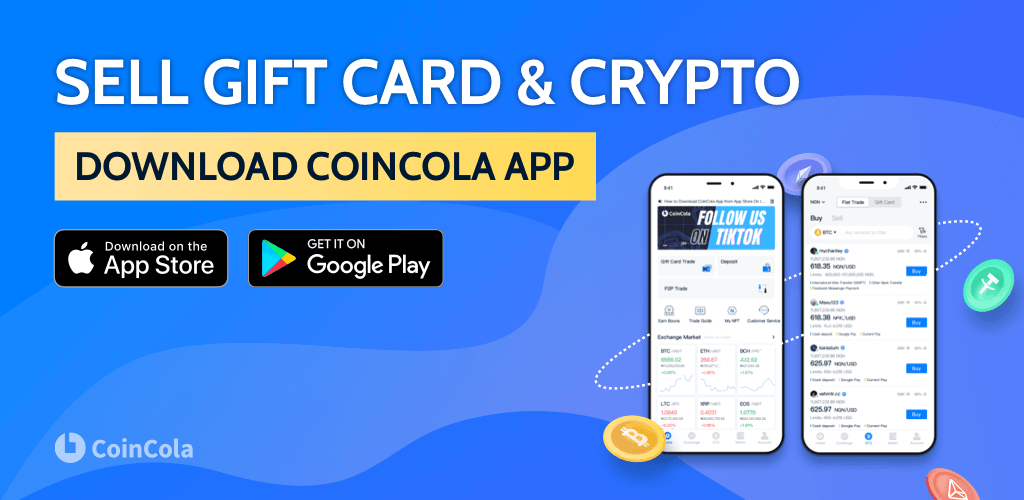
Ready to buy Bitcoin with MoMo? Download the CoinCola app today and compare vendors in the GHS market.
Related reading: how to convert Bitcoin to cedis in Ghana, the Ghana P2P vendor promotion, sending money from Ghana to Nigeria, and which wallet apps support USDT TRC20.
This is not financial advice. Always DYOR (Do Your Own Research).
Stay blessed, stay smart. 🚀