Cheapest Way to Send Money to Nigeria in 2026 (All Methods Compared)

Sending $300 to Nigeria every month? You could be losing $10–45 in fees you don’t need to pay. This guide breaks down the real cost of every major transfer method in 2026 — and shows you the cheapest route available today.
If you’re sending money back home to Nigeria, you already know the frustration. You work hard for that money, and then a chunk of it disappears into fees before your family even sees a naira.
Here’s the thing — it doesn’t have to be that way.
According to World Bank remittance data, the average cost to send $200 to Sub-Saharan Africa is still above 7% in 2026. That means for every $300 you send, over $20 could be eaten by fees and exchange rate margins. Per month. Every month.
This guide cuts through the noise and gives you the actual numbers — no vague promises, no fine print buried at checkout. Let’s find you the cheapest way to send money to Nigeria.
Why Transfer Fees to Nigeria Are Still So High
Most people think they’re paying a straightforward transfer fee. But traditional providers make money in two ways:
1. The stated fee — the flat charge or percentage shown upfront.
2. The exchange rate margin — the gap between the real USD/NGN rate and what they offer you. This “spread” is often larger than the headline fee and rarely displayed prominently.
On a $300 transfer, a 3% exchange rate margin quietly takes $9 before the money even moves. Add a flat fee on top and you’re losing $15–25 without realising it.
The Nigerian diaspora — particularly in the USA, UK, and Canada — sends billions home every year. Traditional remittance companies have built entire business models around these hidden margins. But in 2026, there are alternatives.
The Real Cost: Every Method Compared
Let’s run the numbers on a $300 transfer to a Nigerian bank account.
| Method | Platform Fee | Exchange Rate Margin | Total Cost on $300 | Transfer Time | Available 24/7 |
|---|---|---|---|---|---|
| CoinCola P2P (USDT) | 0% | ~0.5–1.5% (live P2P market) | $1.50–4.50 | 10–30 min | ✅ |
| Wise | 0.4–1.2% + ~$1.50 fixed | ~1–2% spread | $6–10 | 1–2 business days | ❌ |
| Lemfi (formerly LemFi) | 0% fee | ~1.5–3% spread | $4.50–9 | Minutes–hours | ✅ |
| Western Union | 1–5% | Built-in spread | $10–20 | Instant–3 days | ✅ |
| MoneyGram | 1–4% | ~2–3% spread | $9–21 | Instant–3 days | ✅ |
| Bank Wire (SWIFT) | $25–45 flat | 3–5% spread | $34–60 | 3–5 business days | ❌ |
| PayPal International | ~5% | 3–4% spread | $24–27 | 1–3 business days | ❌ |
| Cash App (via crypto) | 1.75% conversion fee | Market rate | ~$5 | Minutes | ✅ |
Exchange rate margins are estimates based on typical offers in 2026. Actual rates vary by day and provider.
The standout: CoinCola P2P costs $1.50–4.50 on a $300 transfer, versus $10–20 on Western Union and $34–60 on a bank wire. If you send $300 every month, that’s potentially $100–200 saved per year.
Hidden Fees to Watch Out For
Before you commit to any service, check for these:
“No fee” that isn’t really no fee. Some services advertise zero transfer fees but build their profit into a weak exchange rate. Always check the rate they’re giving you against the mid-market rate (Google “USD to NGN” for the real rate). A 3% spread on $300 is $9 — that’s a fee, just not labelled as one.
Weekend and holiday rate adjustments. Several providers offer worse exchange rates on weekends when interbank markets are closed. Always check the rate, not just the fee.
Minimum transfer amounts. Some providers are only cheap at higher amounts. Below $100–200, flat fees dominate and make the transfer expensive percentage-wise.
Receiving bank charges. In rare cases, Nigerian banks may deduct a small receiving fee. GTBank, Access Bank, and Zenith typically don’t charge for incoming USDT/crypto-sourced Naira on P2P platforms, but it’s worth confirming with your recipient.
Funding method surcharges. Funding a transfer with a credit card instead of a bank account or Zelle often adds 1.5–2.5% on top of the base fee. Always use a bank debit option where possible.
Why Crypto P2P Wins on Cost
The cheapest method consistently available in 2026 is crypto P2P — specifically, sending USDT (Tether, a stablecoin pegged to the US dollar) through a P2P marketplace like CoinCola.
Here’s why it undercuts every traditional option:
No correspondent banks. International wire transfers pass through 2–3 intermediary banks, each taking a cut. USDT moves wallet-to-wallet — there are no intermediaries.
Zero platform fees. CoinCola charges no transaction fee on P2P trades. The exchange rate between USDT and Naira is set by competition among P2P sellers in Nigeria — buyers compete, which keeps the spread tight.
USDT doesn’t fluctuate like Bitcoin. Unlike sending Bitcoin, USDT is pegged 1:1 to the US dollar. Your $300 stays $300 from the moment you buy USDT to the moment your family converts it to Naira. No volatility risk during the transfer.
Your family in Nigeria doesn’t need crypto experience. This is the key barrier most people assume exists — and it doesn’t. Your relative in Nigeria just needs a free CoinCola account. They receive USDT, sell it for Naira through the P2P marketplace, and it goes straight to their GTBank, Access, or Zenith account. The crypto part is invisible to them.
Real example: Sending $300 via Western Union typically costs $10–15 in combined fees and spread. The same $300 sent as USDT via CoinCola P2P costs $1.50–4.50 total — saving $8–13 on one transaction. At 12 transfers per year, that’s $96–156 back in your pocket.
How CoinCola’s Zero-Fee Transfer Works
The process has four steps and takes 10–30 minutes total:
Step 1 — You buy USDT on CoinCola (USA/UK/Canada side)
Create a free account at coincola.com. Go to Buy Bitcoin → select USDT. Choose a verified P2P seller and pay via Zelle, bank transfer, or your preferred method. USDT arrives in your wallet within 5–15 minutes.
Step 2 — You send USDT to your family’s wallet
Ask your family member to create a free account on coincola.ng and share their USDT (TRC20) wallet address. You send from your CoinCola wallet — takes 1–5 minutes on the TRC20 network.
Step 3 — Your family sells USDT for Naira
They go to coincola.ng/sell-bitcoins-online/fiat_balance, place a sell order for NGN, and pick a buyer. The platform holds USDT in escrow until the buyer transfers Naira.
Step 4 — Naira lands in their Nigerian bank
Once the buyer confirms the Naira payment, USDT is released and Naira goes to your family’s bank account. End to end: 10–30 minutes.
For a full walkthrough of this process, see our guide: How to Send USDT to Nigeria from the USA.
Tips to Get the Cheapest Rate Every Time
Even within the cheapest method, small habits can save you more:
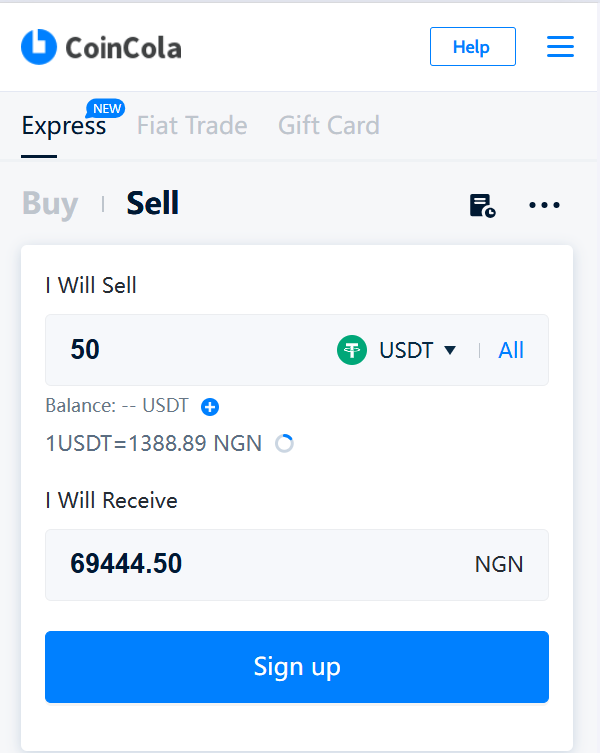
Compare P2P sellers before accepting. Your family should scroll through the top 5–10 active offers on coincola.ng before selecting. High-volume sellers with 500+ trades and 95%+ completion rates tend to offer the most competitive rates to attract volume.
Trade mid-week, mid-day. Nigerian P2P activity peaks on Fridays and late evenings (GMT+1). Mid-morning on Tuesday–Thursday typically sees more competitive offers as sellers compete for trade volume.
Use TRC20, not ERC20. USDT runs on multiple networks. TRC20 (Tron network) has far lower transaction fees than ERC20 (Ethereum network) — often under $0.50 vs $1–5. Always confirm your family selects TRC20 when sharing their wallet address.
Send in larger amounts. If your budget allows, consolidating two smaller transfers into one reduces the relative impact of the P2P spread and any on-chain network fees.
Check the mid-market rate before sending. Google “USD NGN” to see the real exchange rate. If a P2P offer is within 1–2% of that rate, it’s competitive. More than 3% spread? Keep scrolling.
Which Method Should You Use?
| Your situation | Best method |
|---|---|
| Want absolute lowest fees, OK with 30-min process | CoinCola P2P (USDT) |
| Want low fees with a traditional-looking service | Wise or Lemfi |
| Need cash pickup in Nigeria (not bank) | Western Union or MoneyGram |
| Sending a large one-time amount (>$2,000) | Wise or CoinCola P2P (avoid flat-fee bank wires) |
| Family has no bank account, needs mobile wallet | CoinCola P2P → OPay wallet |
| Already have crypto and want to skip buying step | CoinCola P2P direct |
Bottom line: For pure cost efficiency, crypto P2P via CoinCola is the cheap way send money to Nigeria in 2026. If you want a familiar-feeling app without any crypto setup, Wise or Lemfi are your next-best options. Traditional bank wires and Western Union should be your last resort for regular transfers.
FAQs
Yes. Sending USDT is legal in the United States. In Nigeria, P2P USDT-to-Naira trading is legal under the Central Bank of Nigeria’s regulatory framework for Virtual Asset Service Providers. CoinCola operates as a compliant P2P marketplace in both markets.
For overall cost (fees + exchange rate), CoinCola P2P consistently offers the lowest total cost. Among traditional apps, Lemfi and Wise are generally cheaper than Western Union or PayPal for regular transfers.
Yes, Wise supports NGN transfers to Nigerian bank accounts. The fees are typically 0.4–1.2% plus a small fixed fee, with a competitive exchange rate close to mid-market. It’s one of the better traditional options, but still more expensive than crypto P2P.
Western Union’s fees vary by origin country, amount, and payment method. For a $300 transfer from the USA, you can expect to pay $10–20 in combined fees and exchange rate spread depending on how you fund the transfer.
Western Union’s fees vary by origin country, amount, and payment method. For a $300 transfer from the USA, you can expect to pay $10–20 in combined fees and exchange rate spread depending on how you fund the transfer.
Yes — through mobile wallets. On CoinCola, Naira can be received into OPay or Palmpay wallets in addition to traditional bank accounts. For cash pickup, Western Union and MoneyGram both have agent networks across Nigeria.
There’s no minimum set by CoinCola itself. However, P2P sellers on coincola.ng typically set minimum order sizes — most active sellers accept trades from $10 equivalent upward. Check the seller’s listed minimum before placing an order.
CoinCola uses escrow protection on all P2P trades. The USDT is locked in escrow until the Naira payment is confirmed — meaning your family’s funds are protected throughout the trade. The platform also has KYC verification and a dispute resolution process if anything goes wrong.
Start Sending Today — Zero Platform Fees
The cheapest way to send money to Nigeria in 2026 is through P2P crypto — and it’s more accessible than most people think. Your family doesn’t need crypto experience. You don’t need a special account. Just a free CoinCola wallet on each side.
Ready to stop losing money on fees? Let’s get that transfer sorted 🚀
- Send Money to Nigeria — Get Started Free
- Your Family: Sell USDT for Naira on CoinCola Nigeria
- Step-by-Step: How to Send USDT to Nigeria from the USA
This is not financial advice. Exchange rates and fees fluctuate — always check the current rate before sending. Always DYOR (Do Your Own Research). 🙏