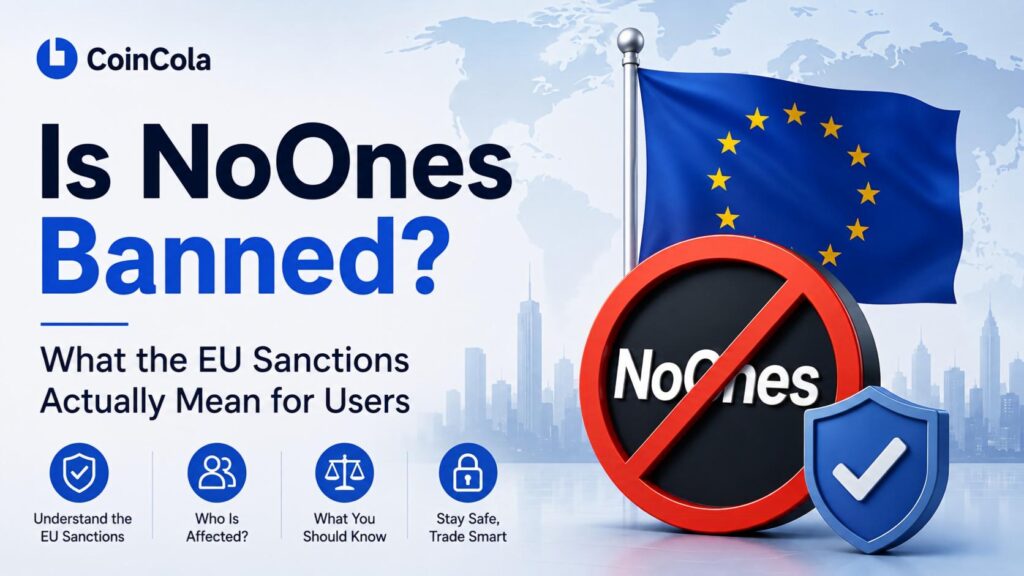
Is noones shutting down? What the EU Sanctions Actually Mean for Users
Yes, with NoOnes shuttering its Gift Card Store and P2P marketplace following their official announcement, gift card arbitragers and P2P traders need an immediate replacement. CoinCola is one of the most trusted global platforms for trading gift cards directly for crypto or fiat. With high escrow safety standards, rapid dispute resolution, and competitive gift card rates, CoinCola ensures your trading profits stay safe and active.
The European Union’s 21st sanctions package, adopted in July 2026, introduced transaction restrictions involving certain crypto service providers, including NoOnecrypto INC.. However, this is not the same as a global shutdown or worldwide ban.
Whether these sanctions affect you depends on several factors, including:
- Where you live
- Whether you’re an EU individual or business
- The regulations that apply in your jurisdiction
- How you use cryptocurrency
If you’re a NoOnes user, the most important step is to understand what the EU actually announced, rather than relying on headlines or social media discussions.
This guide explains the facts behind the sanctions, who may be affected, and what users should consider before making decisions.
Is NoOnes Banned?
Short Answer
Yes.
NoOnes’ P2P marketplace was closed on August 21, with its Swap, Visa card, fiat withdrawal, and Lightning Network services also discontinued. August 23 was set as the final deadline for users to withdraw their remaining assets.
As the sanctions took full effect on August 23, NoOnes warned that funds remaining on the platform could face potential compliance, operational, and technical risks. Users were therefore advised to withdraw their assets before the deadline.
What Did the EU Actually Announce?
The confusion surrounding NoOnes largely stems from the European Union’s 21st sanctions package, adopted on 23 July 2026.
The package introduced one of the most significant updates to the EU’s sanctions framework in recent years, targeting hundreds of individuals, organizations, financial institutions, and service providers connected to Russia’s sanctions evasion efforts.
Among the measures announced was a transaction ban involving 14 crypto-related service platforms, including NoOnes.
According to the European Council, these measures are intended to prevent sanctioned entities from using certain cryptocurrency services to circumvent existing sanctions.
The package also introduced a new legal mechanism that could, under certain circumstances, allow broader restrictions involving crypto-asset service providers operating in third countries.
Importantly, the announcement does not state that NoOnes has been shut down worldwide.
Instead, it introduces legal restrictions that apply within the scope of EU sanctions law.
Transaction Ban vs Global Ban
This distinction is one of the most misunderstood aspects of the news.
Many articles and social media posts use the word “banned” because it is short and attention-grabbing.
However, from a regulatory perspective, there is a significant difference between:
Transaction Restrictions
A transaction restriction limits or prohibits certain transactions under specific legal conditions.
Who is affected depends on the applicable sanctions rules and the parties involved.
Global Platform Shutdown
A global shutdown would generally mean that a platform has ceased operating entirely or become inaccessible to all users worldwide.
Understanding this distinction helps explain why users in different countries may experience different practical implications.
Whenever reading headlines about sanctions, it’s worth checking the original legal announcement before assuming that a platform has stopped operating altogether.
Why Was NoOnes Included?
According to the European Union, the platforms listed in the sanctions package were identified as having allegedly enabled or facilitated activities related to sanctions evasion involving Russian entities.
The European Council’s measures focus on restricting transactions involving designated entities rather than making broader statements about every user of those platforms.
If you’d like a more detailed explanation of why NoOnes was included in the sanctions package, we’ve published a separate guide that examines the announcement, the regulatory background, and what it means in the broader context of cryptocurrency compliance.
Why Compliance Matters More Than Ever
The cryptocurrency industry has changed significantly over the past few years.
Governments around the world are introducing stronger frameworks covering:
- Know Your Customer (KYC)
- Anti-Money Laundering (AML)
- Transaction monitoring
- Risk management
- Sanctions compliance
As a result, users are paying more attention to the long-term stability and compliance practices of the platforms they choose.
When evaluating any P2P marketplace, it’s worth considering more than just fees or available cryptocurrencies.
Factors such as escrow protection, merchant reputation, dispute resolution, customer support, and compliance practices all contribute to the overall trading experience.
If you’re new to peer-to-peer marketplaces, our guide to P2P Crypto Trading explains how escrow works, how to evaluate merchants, and how to reduce trading risks.
What’s Next?
Understanding the sanctions announcement is only the first step.
The next questions most users ask are:
- Does this affect me if I live outside the EU?
- Can Nigerian users still use NoOnes?
- Is my cryptocurrency at risk?
- Should I continue using NoOnes?
- What should I consider before switching platforms?
In the next section, we’ll answer these practical questions and explain what different groups of users should know before making decisions.
Who Is Actually Affected by the EU Sanctions?
One of the biggest misconceptions surrounding the EU’s sanctions package is that it affects every NoOnes user in the same way.
In reality, the impact depends on your location, the parties involved in a transaction, and the regulations that apply to you.
For most users, it’s more helpful to ask:
“Do these sanctions apply to my situation?”
rather than simply,
“Is NoOnes banned?”
Let’s look at different user groups.
EU Individuals and Businesses
If you are an individual or business located in the European Union, the sanctions package is likely to be more directly relevant.
The EU’s measures introduce restrictions on transactions involving designated crypto service providers, meaning that EU persons and entities should understand the applicable legal requirements before conducting business with listed platforms.
Because sanctions law can be complex, users should always rely on official guidance rather than social media discussions.
Users Outside the European Union
If you live outside the EU, the situation may be different.
The EU’s sanctions package does not automatically prohibit every user worldwide from accessing or using a listed platform.
However, users outside Europe should still stay informed because regulatory developments can sometimes influence:
- banking relationships,
- payment providers,
- liquidity,
- business partnerships,
- and the availability of certain services in different regions.
For this reason, it’s good practice to monitor official platform announcements and understand the regulations that apply in your own country.
Can Nigerian Users Still Use NoOnes?
Not for normal trading anymore. Based on NoOnes’ latest official wind-down announcement, its P2P marketplace closed on August 21, 2026, and the platform moved into a withdrawal-only phase. This applies to Nigerian users as well as users in other markets.
NoOnes also announced the closure of services including Swap, NoOnes Visa, crypto off-ramps, the Gift Card Store, and the Bitcoin Lightning Network. The platform advised users to withdraw their remaining balances as soon as possible, with August 23, 2026 given as the recommended deadline.
For users who still have funds on NoOnes, the official announcement listed withdrawals via the Bitcoin network and USDT on TRC-20, but warned that external exchanges or wallet providers may delay, reject, or subject NoOnes-related transactions to additional compliance reviews. Users should therefore check whether the receiving platform can accept the transfer before sending funds.
In short: Nigerian users may still be able to access their accounts for available withdrawal functions, but NoOnes is no longer operating as a normal P2P trading platform. If you still have funds on the platform, check your account status and the latest official withdrawal instructions before taking action.
What About Users in Other Countries?
The same principle applies to users in countries such as:
- Ghana
- Kenya
- South Africa
- the United Kingdom
- Canada
- Australia
- Singapore
- the United States
Every jurisdiction has its own regulatory framework.
A sanctions announcement issued by one authority should not automatically be interpreted as a worldwide operational ban.
Before making decisions, users should always consider:
- local laws,
- official platform announcements,
- and guidance from relevant authorities.
Is My Crypto Safe?
Another common concern is whether the sanctions announcement automatically affects existing user funds.
The answer depends on individual circumstances.
Public announcements about sanctions should not be interpreted as confirmation that all user assets are frozen or inaccessible.
Instead, users should:
- monitor official platform announcements,
- review any notices relating to withdrawals or deposits,
- keep personal wallets secure,
- enable two-factor authentication (2FA),
- and avoid relying on unverified information shared through social media.
As a general best practice, many experienced cryptocurrency users prefer to maintain control of their digital assets by using secure personal wallets whenever appropriate, rather than leaving large balances on any trading platform for extended periods.
What If You’re Looking for Alternatives?
Regulatory news often encourages users to compare platforms and better understand the options available.
That doesn’t necessarily mean switching is the right decision—but comparing alternatives can help users identify platforms that best suit their trading needs.
When evaluating different P2P marketplaces, consider:
- Escrow protection
- Merchant reputation
- Liquidity
- Trading volume
- Payment methods
- Customer support
- Compliance practices
- Overall user experience
If you’re researching other platforms, our comprehensive comparison of NoOnes Alternatives explores several popular P2P exchanges and explains what to consider before choosing one.
How to Choose a Safe P2P Crypto Exchange
Whether you’re considering NoOnes, CoinCola, or another marketplace, the same evaluation principles apply.
1. Look for Escrow Protection
Escrow is one of the most important safety mechanisms in P2P trading.
A platform that temporarily holds cryptocurrency until both parties complete their obligations significantly reduces trading risk.
2. Check Merchant Reputation
Experienced traders rarely choose merchants based on price alone.
Instead, they often review:
- completed trades,
- completion rate,
- response time,
- account history,
- user feedback.
Reliable merchants usually provide a smoother trading experience than simply selecting the lowest-priced offer.
3. Review Payment Methods
Payment flexibility matters.
A platform should support payment methods commonly used in your country.
More active payment options generally create a more competitive marketplace.
4. Understand the Dispute Process
Even experienced traders occasionally encounter issues.
Knowing how disputes are handled before you begin trading can help reduce stress if something unexpected occurs.
5. Enable Security Features
Always enable:
- Two-factor authentication (2FA)
- Strong passwords
- Identity verification where appropriate
- Login notifications
Small security improvements can significantly reduce account risk.
If you’re new to escrow-based marketplaces, our P2P Crypto Trading Guide explains these concepts in more detail and provides practical tips for trading safely.
Beyond Trading: Why More Users Are Using Crypto for International Money Transfers
Cryptocurrency today is about much more than buying and selling Bitcoin.
Increasingly, individuals are using digital assets for practical, everyday financial activities, including international money transfers.
Instead of relying solely on traditional banking networks, some users choose to transfer cryptocurrency across borders and convert it into local currency through trusted P2P marketplaces.
Common use cases include:
- Supporting family members overseas
- Paying freelancers
- Receiving international business payments
- Sending emergency funds
- Reducing cross-border transfer costs
For many people, P2P marketplaces have become part of a broader international payment workflow rather than simply a place to trade crypto.
If you’re interested in this use case, our International Money Transfer guide explains how crypto can be used to support faster and more flexible cross-border payments.
Key Takeaways
Before making any decisions based on headlines, remember these important points:
- A transaction restriction is not automatically the same as a global platform ban.
- Regulatory impacts vary depending on your jurisdiction.
- Always verify information using official sources.
- Evaluate platforms based on security, escrow, merchant quality, liquidity, and compliance—not just fees.
- Consider your own trading goals before deciding whether to continue using a platform or explore alternatives.
In the final section, we’ll answer the most frequently asked questions about NoOnes, summarize what users should know, and provide practical guidance for navigating regulatory changes in the evolving crypto industry.
Frequently Asked Questions
According to the official schedule:
August 17, 2026: Swap, Gift Card Store, Visa Card, and Partner Program features begin shutting down.
August 21, 2026 (11:59 PM UTC): The P2P Marketplace closes permanently, ending all buying and selling activities.
Post-August 21, 2026: The platform transitions to a strict withdrawal-only mode.
To facilitate fund removal during the shutdown, NoOnes is automatically transitioning accounts currently on “hold” status to a “banned” status. This specific system change is designed to disable all trading and market features while enabling account sign-in and withdrawal access.
CoinCola is the leading alternative for former NoOnes users, vendors, and gift card traders. CoinCola provides:
High Liquidity & Low Fees: Deep order books for USDT, BTC, and major cryptocurrencies.
Global & Local Payment Options: Full support for local bank transfers, mobile money, and local fiat wallets (including dedicated Naira trading options).
Robust Escrow Security: Military-grade escrow protection for both P2P crypto trades and gift card transactions.
Fast Vendor Onboarding: Verified vendor accounts for high-volume traders migrating from NoOnes.
No. CoinCola does not accept deposits sent directly from NoOnes. Do not enter a CoinCola deposit address when withdrawing from your NoOnes account.
If your funds are still on NoOnes, check its current withdrawal instructions and confirm that your intended destination accepts transfers from NoOnes before sending. For account access, withdrawal and trading questions, read our guide to NoOnes login, account and P2P status in the Philippines.
If you already sent funds to another platform and it rejected the deposit, follow that platform’s official support process. If it formally approves a refund, a return sent by that platform may be considered for receipt at CoinCola, subject to current account and deposit requirements. Confirm the sending platform, asset and network before providing an address. Read our guide to rejected NoOnes deposits and refunds for details.
Publicly available information about the EU sanctions package should not be interpreted as meaning that every user’s funds are frozen. If you have concerns about your account, always check official platform announcements or contact the platform’s customer support directly.
Withdrawal availability depends on the platform’s operational policies and your individual account circumstances. Users should verify the latest information directly from official sources.
According to the European Union, the listed platforms were designated in connection with concerns relating to sanctions evasion. For a more detailed explanation of the regulatory background, see our article: Why Was NoOnes Sanctioned? Everything Crypto Users Need to Know (2026)
Yes! To assist top-volume vendors and P2P merchants affected by the NoOnes closure, CoinCola offers a Fast-Track Vendor Migration Program. By providing proof of your trading history and feedback metrics from NoOnes, you can qualify for expedited KYC verification, vendor badge status, reduced escrow fees, and priority 24/7 customer support.
9. Should I move to another platform?
That depends on your individual circumstances.
Factors worth considering include:
- security,
- merchant quality,
- escrow protection,
- payment methods,
- customer support,
- liquidity,
- and compliance.
10. How do I compare different P2P exchanges?
Instead of focusing only on fees, compare:
- escrow protection,
- merchant reputation,
- trading activity,
- dispute resolution,
- supported payment methods,
- security features.
If you’re researching alternatives, our comparison may help.
11. What is escrow in P2P trading?
Escrow temporarily holds cryptocurrency until both parties have completed the agreed transaction.
It is one of the most important features for reducing fraud in peer-to-peer trading.
If you’re new to P2P marketplaces, read our: Secure Trading: Best USDT to Naira Binance P2P Alternatives
12. Does this affect gift card trading?
The sanctions announcement itself does not specifically address gift card trading.
However, users should always check whether individual merchants, payment methods, or platform policies have changed.
13. Can I still buy Bitcoin?
Whether you can buy Bitcoin depends on your location, available merchants, payment methods, and applicable regulations.
14. Can I still sell USDT?
In many jurisdictions, users continue to trade USDT through P2P marketplaces.
However, users should ensure they comply with local regulations and platform policies.
15. Does this affect international money transfers?
Many people use cryptocurrency as part of international money transfers.
If you’re interested in learning how crypto can support cross-border payments, see our guide: SWIFT vs Blockchain: Which Is Faster and Cheaper for International Transfers?
16. Is CoinCola affected by the EU sanctions package?
At the time of writing, CoinCola is not among the crypto platforms listed in the EU’s 21st sanctions package.
Users should nevertheless monitor official announcements and regulatory developments, as compliance requirements may evolve over time.
17. Where can I find official information?
The most reliable sources include:
- The European Council
- Official platform announcements
- Chainalysis research
- Your local financial regulator
18. What should users do now?
Rather than reacting to headlines alone, users should:
- verify information from official sources,
- understand the regulations applicable to their jurisdiction,
- evaluate platform security,
- enable account protection features,
- and make decisions based on their own financial needs.
How to Stay Safe During Regulatory Changes
Cryptocurrency regulation continues to evolve around the world.
Whether you’re using NoOnes, CoinCola, or any other P2P marketplace, the same best practices apply.
Consider the following checklist:
✔ Enable two-factor authentication (2FA)
✔ Use strong, unique passwords
✔ Verify merchant reputation before every trade
✔ Keep large crypto holdings in secure personal wallets where appropriate
✔ Read official platform announcements before reacting to news reports
✔ Be cautious of scams that often appear during major regulatory events
✔ Never release escrow until payment has been fully confirmed
Good security habits remain one of the best ways to reduce risk, regardless of which platform you use.
Final Thoughts
The question “Is NoOnes banned?” became increasingly common following the EU’s latest sanctions measures and NoOnes’ subsequent decision to wind down its services.
The EU sanctions involved restrictions on transactions with designated crypto service providers, while NoOnes later announced the closure of its P2P marketplace and other services. This means users should distinguish between the regulatory measures themselves and the platform’s subsequent operational shutdown.
For users, the most important takeaway is to rely on official announcements, understand the current status of the platform, and consider how regulatory developments and service closures may affect their own funds and transactions.
Whether you previously used NoOnes or are now comparing other P2P platforms, factors such as security, escrow protection, merchant quality, dispute resolution, customer support, and regulatory compliance remain important when choosing where to trade.
Together, these guides provide additional context on the sanctions, NoOnes’ service shutdown, alternative P2P platforms, trading safety, and practical crypto use cases beyond simply buying and selling digital assets.
Disclaimer
This article is provided for informational and educational purposes only.
It does not constitute legal, financial, investment, tax, or compliance advice.
Regulations governing cryptocurrency vary by country and may change over time. Readers should always refer to official announcements and consult qualified legal or financial professionals where appropriate before making decisions based on regulatory developments.