Bitcoin P2P in the Philippines: How to Buy and Sell BTC With PHP
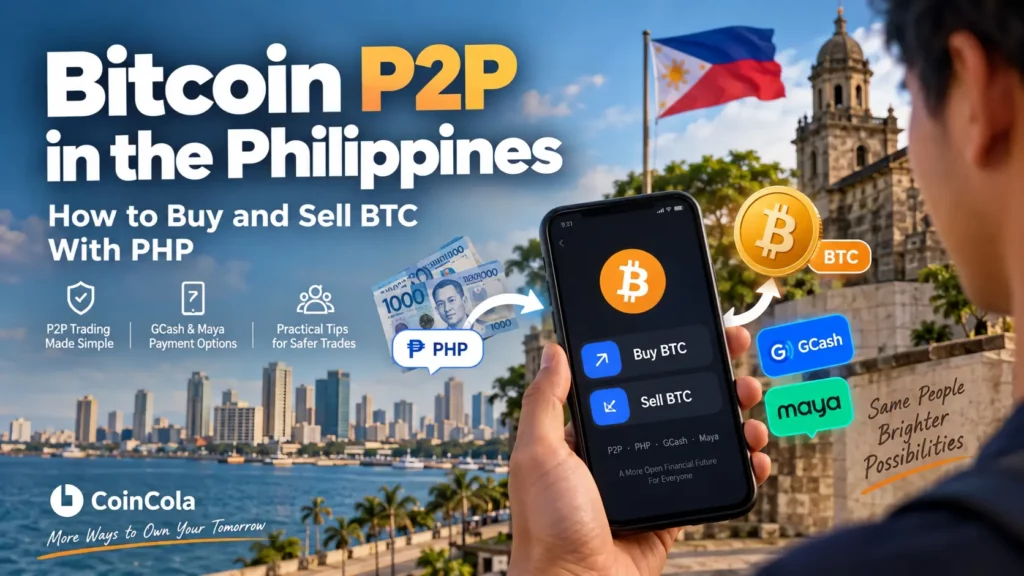
If you’re in the Philippines and want to buy or sell Bitcoin, the practical question is usually not “How does Bitcoin work?”
It’s:
How do I turn PHP into BTC — or BTC back into PHP?
P2P trading is one way to do that. Instead of accepting one fixed BTC/PHP conversion rate, you choose from offers posted by individual traders. Depending on the offer, you may be able to use GCash, Maya, a bank transfer, or another local payment method.
That flexibility is useful, but it also means you need to look at more than the price.
The amount you want to trade, the payment method, the order limit and the trader behind the offer can all change whether a particular deal actually works for you.
After working around P2P markets, one thing I’ve found especially useful to remember is this:
The most useful P2P price isn’t necessarily the lowest one. It’s the price attached to a trade you can actually complete.
How Bitcoin P2P Works in the Philippines
The basic idea is simple.
If you want to buy Bitcoin, you have PHP and look for someone selling BTC.
PHP → BTC
If you want to sell Bitcoin, you already have BTC and look for someone willing to pay you PHP.
BTC → PHP
The marketplace brings the two sides together and provides the transaction process, usually including escrow.
Individual offers can differ in four important ways:
- Price
- Order limit
- Payment method
- Trader
That’s why two people looking at the same BTC/PHP market can end up choosing completely different offers.
Someone buying ₱2,000 of Bitcoin may have plenty of choices. Someone selling ₱100,000 worth of BTC needs to pay much more attention to available limits and liquidity.
P2P is therefore less like checking a currency converter and more like choosing a transaction from a marketplace.
Buying Bitcoin With PHP
If you have pesos and want Bitcoin, start with the BTC/PHP market.
You don’t need to purchase one whole Bitcoin. Bitcoin is divisible, so you can buy a fraction based on how much PHP you want to spend.
For example, if an offer prices Bitcoin at ₱6,000,000 per BTC, a ₱10,000 purchase would represent roughly:
₱10,000 ÷ ₱6,000,000 = 0.00167 BTC
The actual amount you receive will depend on the live offer and any applicable costs.
The more useful question isn’t “How much is one Bitcoin?”
It’s:
“How much BTC can I get for the amount of PHP I actually want to spend?”
That is how I’d approach the market.
Buying Bitcoin With GCash
For many Filipino users, GCash is simply the most familiar way to make the PHP side of a digital transaction.
P2P makes this possible when an individual Bitcoin seller accepts GCash.
The basic process is:
Find BTC/PHP offer → Select GCash → Check the offer → Pay → Receive BTC
The important part is the offer itself.
A marketplace may support GCash, but that doesn’t mean every Bitcoin seller accepts it.
Before opening an order, check that:
- GCash is listed as the payment method
- Your amount falls within the seller’s limits
- The seller’s terms are clear
- The offer is still active
CoinCola currently has a dedicated Bitcoin/GCash P2P page where users can view available offers.
Buy Bitcoin with GCash on CoinCola
If you’re comparing offers, I’d look at the whole transaction rather than simply sorting by the lowest price.
Selling Bitcoin for PHP
Selling Bitcoin works in the opposite direction:
BTC → PHP
You find a buyer who is willing to purchase your BTC and pay you in PHP.
Depending on the offer, that payment could go to GCash, Maya, a bank account or another supported method.
The process is straightforward:
- Choose BTC/PHP.
- Find a suitable buyer.
- Check the payment method and order limit.
- Open the P2P order.
- Wait for the PHP payment.
- Verify the payment in your own account.
- Release the BTC according to the order process.
There is one point here that deserves special attention.
Never release Bitcoin because someone sends you a payment screenshot.
If you’re expecting ₱50,000, open your own GCash, Maya or banking app and verify that the ₱50,000 is actually there.
A screenshot is evidence of a screenshot.
It isn’t evidence that you received the money.
CoinCola also provides a dedicated BTC/GCash route for users looking to sell Bitcoin for PHP.
Sell Bitcoin for GCash on CoinCola
Why Is the Bitcoin P2P Price Different From the Market Price?
This is one of the first things that can confuse new P2P users.
You check the Bitcoin price online and see one number.
Then you open a BTC/PHP P2P market and see something different.
That’s normal.
A global BTC price is a reference. A P2P BTC/PHP price is a transaction offer.
For example:
| Price | |
|---|---|
| Global reference price | ₱6,000,000/BTC |
| P2P offer | ₱6,100,000/BTC |
The ₱100,000 difference doesn’t necessarily mean that someone has simply added an arbitrary fee.
A P2P trader is offering a particular combination of:
- BTC liquidity
- PHP liquidity
- Payment method
- Order size
- Speed
- Convenience
- Trading margin
Local demand and Bitcoin’s volatility can also affect what traders are willing to quote.
This is why I wouldn’t automatically describe a P2P premium as “bad.”
I’d ask a different question:
What am I getting for the difference in price?
If one offer lets you complete the exact ₱20,000 GCash transaction you need immediately, while a cheaper offer only accepts ₱2,000, the cheaper number isn’t particularly useful.
Is the Cheapest Bitcoin P2P Offer the Best?
Not necessarily.
Consider two offers:
| Trader A | Trader B | |
|---|---|---|
| BTC price | ₱6,000,000 | ₱6,030,000 |
| Order limit | ₱500–₱5,000 | ₱1,000–₱20,000 |
| Payment | GCash | GCash |
If you want to buy ₱15,000 of BTC, Trader A isn’t really competing with Trader B.
Trader A’s price looks better.
Trader B is actually able to complete your transaction.
That’s an important distinction.
A good P2P offer is a usable offer.
This is particularly relevant as the transaction gets larger. At ₱1,000, a small difference in price may be more important than liquidity. At ₱100,000, finding someone who can actually handle the order can become the bigger issue.
What Makes a Good Bitcoin P2P Offer?
Rather than asking which trader is “the best,” I think it’s more useful to ask whether a particular offer fits your transaction.
Look at five things.
Price
Obviously, you don’t want to ignore the rate.
But price only makes sense in the context of the rest of the offer.
Order limit
Can the trader handle the amount you actually want to buy or sell?
Payment method
If you need GCash, an offer that only accepts bank transfer isn’t useful to you.
Trader history
Completed transactions and available account information give you some context about who you’re dealing with.
They aren’t a guarantee, but they are worth checking.
Terms
Read the advertiser’s instructions before making a payment.
If something doesn’t make sense, don’t rush into the transaction.
Bitcoin P2P Safety: The Risks That Actually Matter
P2P safety advice often becomes a long list of generic crypto warnings.
The risks that matter most during an actual Bitcoin P2P trade are much more specific.
Fake payment
Someone says they have paid.
You don’t see the money in your account.
Don’t release BTC.
Simple.
Third-party payments
Suppose you’re trading with John, but the PHP payment comes from Maria.
Don’t automatically assume that’s fine.
Check the order terms and follow the platform’s process before releasing anything.
Moving the trade off-platform
A trader may tell you:
“Cancel the order. I’ll give you a better rate directly.”
This removes one of the main reasons for using a P2P marketplace in the first place.
If the transaction has an escrow and order system, keep the transaction there.
Sending BTC after the trade
There’s another risk that is easy to confuse with P2P itself.
Buying BTC and transferring BTC are two separate transactions.
Once you’ve received your Bitcoin, you may want to send it to another wallet or exchange.
That’s when you need to check the receiving address, supported network and transaction details carefully.
A completed P2P order doesn’t automatically mean a subsequent blockchain transfer will be successful.
Bitcoin P2P vs Buying Bitcoin Through an Exchange
P2P and traditional exchanges solve slightly different problems.
| P2P | Traditional exchange | |
|---|---|---|
| Price | Individual offers | Exchange market |
| Payment | Local methods may be available | Depends on platform |
| GCash | Available on selected offers | Depends on platform |
| Liquidity | Depends on individual advertisers | Depends on exchange liquidity |
| Main consideration | Offer + trader | Platform + market |
If you specifically want to use PHP and a local payment method such as GCash, P2P can be attractive because you can search for an offer that matches those requirements.
If you prefer a conventional order book and trading interface, an exchange may feel more familiar.
Neither approach is automatically better.
It depends on the transaction.
What NoOnes’ Closure Means for Filipino Bitcoin Traders
NoOnes announced that its P2P marketplace would close on August 21, 2026, with the platform moving into withdrawal-only mode afterward.
For users who traded there, that naturally creates a need to find another P2P marketplace.
But I don’t think the bigger story is about replacing one platform with another.
Filipino users still need to buy Bitcoin with PHP.
They still need to sell BTC for pesos.
And they still need local payment methods.
So the more useful question is:
Where can I find the BTC/PHP trade I need today?
That’s a market question, not a brand question.
Where to Find Bitcoin P2P Offers in the Philippines
If you want to compare current BTC/PHP offers, CoinCola provides a P2P marketplace where available advertisements can be compared based on factors such as price, order limits and payment methods.
For GCash users, there are dedicated routes for both sides of the transaction:
The important thing to remember is that these are live markets.
An article can explain how P2P works.
It cannot tell you which trader will have the best usable offer five hours from now.
Prices, limits and available advertisers can change.
So check the live market when you’re actually ready to trade.
A Simple Example: Buying ₱10,000 of Bitcoin
Suppose you have ₱10,000 in GCash and want to buy Bitcoin.
You don’t need to start by asking:
“What is today’s Bitcoin price?”
Start with the transaction you actually want to make.
I have ₱10,000. I want BTC. I want to pay with GCash.
Then look for offers that fit those requirements.
If one seller quotes a slightly lower BTC price but only accepts ₱5,000 maximum, it isn’t the right offer.
If another seller accepts ₱10,000, uses GCash and has reasonable trading history, that offer may make more sense even if its BTC price is slightly higher.
That’s what I mean by a usable price.
A Simple Example: Selling Bitcoin for ₱50,000
Now imagine you already own Bitcoin and want to receive ₱50,000 through GCash.
Your first question shouldn’t be:
“Who pays the most?”
It should be:
“Who can actually handle ₱50,000?”
Then look at the available BTC/PHP offers.
Once you’ve selected an appropriate buyer and opened the order, follow the payment instructions.
When the buyer says the payment has been sent, check your GCash account yourself.
If the PHP has arrived, proceed according to the order.
If it hasn’t, don’t release your BTC.
This is a small operational detail, but it’s one of the most important habits to develop when selling crypto through P2P.
What Filipino Bitcoin P2P Traders Should Know in 2026
If you strip away all the noise around crypto, four things matter when you’re making a BTC/PHP P2P trade:
P2P price is not the same as the global Bitcoin price.
A local offer reflects the conditions of that particular transaction.
Payment methods matter.
GCash, Maya and bank transfers aren’t interchangeable if one of them is how you actually move PHP.
Liquidity matters more as your order gets larger.
The cheapest small offer isn’t useful if it can’t handle your transaction.
And the transaction isn’t finished until you know what happened to your money.
For sellers, that means independently verifying the PHP payment before releasing BTC.
Is Bitcoin P2P Legal in the Philippines?
Whether a particular crypto service is legally permitted or regulated is a separate question from whether P2P trading itself is technically possible.
The Bangko Sentral ng Pilipinas maintains a directory of registered virtual asset service providers and has issued rules and guidance covering virtual asset activities and risk management.
BSP’s January 2026 memorandum also reminded supervised financial institutions to conduct appropriate due diligence when dealing with VASPs and other crypto-asset service providers, including verifying registration or authorization where applicable.
The important distinction for users is:
Being able to access a crypto platform from the Philippines does not, by itself, mean that the platform is BSP-regulated.
If regulatory status matters to your decision, check the current status of the specific provider rather than relying on an advertisement, social media post or old article.
Frequently Asked Questions
Can I buy Bitcoin with PHP in the Philippines?
Yes. P2P marketplaces can match PHP buyers with Bitcoin sellers. The available price, limits and payment methods depend on individual offers.
Can I buy Bitcoin with GCash?
Yes, when a Bitcoin seller’s P2P advertisement supports GCash. Check the individual offer before starting the transaction.
Can I sell Bitcoin for GCash?
Yes. P2P buyers may offer GCash as a payment method. Make sure the buyer’s order limit covers your transaction.
Why is Bitcoin more expensive on P2P?
P2P prices are set by individual traders. Local liquidity, payment methods, order size, demand, volatility and trader margins can all contribute to differences from a global BTC reference price.
Can I buy less than one Bitcoin?
Yes. Bitcoin is divisible, so you can purchase a fraction of BTC.
Is Bitcoin P2P safe?
It can be safer when you use an escrow-based marketplace and follow the transaction process correctly. However, you still need to verify payments, review traders and avoid taking transactions off-platform.
How do I sell Bitcoin safely?
Choose an appropriate buyer, follow the P2P order process and independently verify that the PHP has arrived in your account before releasing BTC.
Does Bitcoin always have the same P2P price?
No. P2P advertisements are dynamic. Prices, order limits, payment methods and available traders can change.
Final Thoughts
Bitcoin P2P in the Philippines isn’t really about finding one perfect BTC price.
It’s about finding a transaction that fits.
If you have PHP and want Bitcoin, you need an offer that matches your amount and payment method.
If you have Bitcoin and want PHP, you need a buyer who can handle your transaction and a payment process you can verify.
That’s why I wouldn’t start with the lowest number on the screen.
Start with the trade you actually need to make.
Then compare the available offers.
For current BTC/PHP P2P offers, you can check what is available on CoinCola:
Prices change. Traders change. Markets change. Check the live offer before you trade.