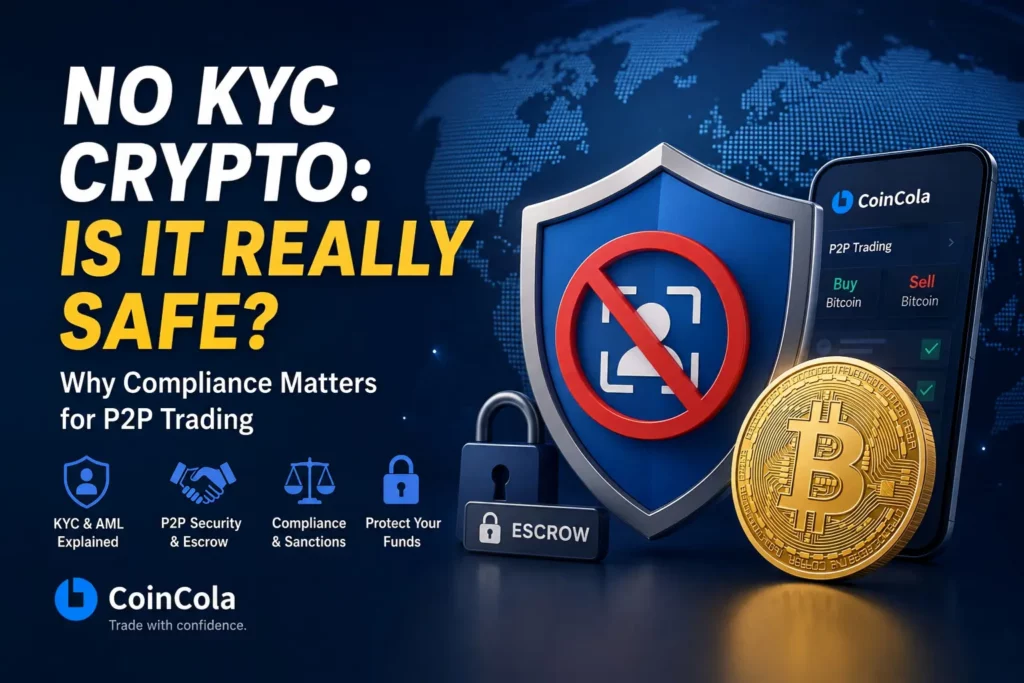
No KYC Crypto: Is It Really Safe? KYC, AML and P2P Security Explained
Key Takeaways
- No KYC is not the same as safe crypto trading.
- KYC and AML controls can help crypto platforms manage fraud and financial-crime risks.
- P2P marketplaces require additional safeguards because users trade with other users.
- Sanctions and compliance issues can create operational risks that ultimately affect users.
- Privacy, convenience, security, and compliance don’t have to be mutually exclusive.
- CoinCola believes responsible compliance is part of building a trustworthy P2P marketplace.
No KYC Sounds Convenient. But Is It Actually Safer?
Search for Bitcoin or crypto trading online and you’ll quickly encounter a familiar promise:
Buy Bitcoin with no KYC.
For many users, the appeal is obvious.
You may not want to upload your passport. You may not want to provide personal information to another financial platform. Or perhaps you simply want to buy Bitcoin without waiting for a lengthy verification process.
These are understandable concerns.
In fact, CoinCola has previously published educational content for users interested in buying Bitcoin with fewer verification requirements.
But there is an important question that often gets overlooked:
Does avoiding KYC actually make crypto trading safer?
The answer is:
Not necessarily.
KYC is only one part of a much larger picture.
When choosing a P2P crypto platform, users should also consider AML controls, transaction monitoring, sanctions screening, escrow protection, account security, dispute resolution, and the platform’s overall approach to risk management.
At CoinCola, this is an important distinction.
We don’t believe that “no KYC” should be treated as a synonym for “safe crypto.”
We believe users deserve to understand the trade-offs before choosing where to trade.
Why Do People Want No KYC Crypto?
Let’s start with the user’s perspective.
People don’t search for “no KYC crypto” for just one reason.
Privacy
Some crypto users value financial privacy and don’t want to share identity documents unless necessary.
That’s a reasonable concern.
The important question is not simply whether a platform collects information, but how it collects, protects, and uses that information.
Speed
Verification can add friction.
Someone who wants to buy Bitcoin quickly may see KYC as an unnecessary delay.
Convenience
Users naturally prefer simple onboarding.
Fewer forms and fewer steps can make a platform easier to use.
Accessibility
Crypto users operate across different countries and financial systems. Verification requirements and access to services can vary considerably between jurisdictions.
These are all legitimate considerations.
But convenience is only one side of the equation.
The other side is risk.
The Problem With Treating “No KYC” as a Security Feature
Here’s the key distinction:
No KYC describes what a platform may not require. It doesn’t tell you what the platform actually does to protect you.
A platform could have limited identity verification while still operating other security controls.
Likewise, requiring KYC does not automatically make a platform safe.
What matters is the overall risk-management framework.
Consider the difference:
| If you focus only on KYC | If you evaluate the whole platform |
|---|---|
| “Do I have to submit ID?” | “How does this platform manage risk?” |
| “Can I trade immediately?” | “How are suspicious transactions handled?” |
| “How anonymous am I?” | “How is my personal information protected?” |
| “How few restrictions are there?” | “What happens if something goes wrong?” |
| “Is there no KYC?” | “Does the platform have responsible controls?” |
This is why CoinCola believes the conversation should move beyond KYC vs. no KYC.
The better question is:
What kind of protection does a crypto platform provide?
What KYC Actually Does
KYC stands for Know Your Customer.
In financial services, KYC procedures are used to establish and verify customer identity.
Depending on the platform and jurisdiction, this can involve:
- Government-issued identification
- Identity verification
- Facial or liveness verification
- Residency information
- Customer risk assessment
- Sanctions screening
- Additional verification where required
KYC does not eliminate every type of crypto risk.
But it can give a platform important information about who is using its services.
That information can become particularly important when a platform needs to investigate:
- Fraud
- Account abuse
- Suspicious activity
- Stolen funds
- Account takeovers
- Other financial risks
From a platform operator’s perspective, this matters.
You cannot effectively manage every risk if you have no meaningful way to understand who is participating in the marketplace.
KYC Isn’t AML
These two terms are often used together, but they aren’t identical.
KYC
Know Your Customer focuses primarily on establishing customer identity.
AML
Anti-Money Laundering refers to broader policies and controls designed to identify and manage risks related to money laundering and other financial crimes.
AML controls can include:
- Customer risk assessment
- Transaction monitoring
- Suspicious activity detection
- Sanctions screening
- Enhanced due diligence
- Reviews of unusual transaction patterns
- Account restrictions or additional verification where appropriate
In simple terms:
KYC helps answer “Who are you?”
AML helps answer “What risks are associated with your activity?”
For a serious crypto platform, both questions matter.
Why Compliance Matters Even More in P2P Crypto
P2P trading is different from traditional exchange trading.
You’re not simply interacting with an order book.
You’re potentially trading with another person.
That introduces another layer of counterparty risk.
For example, a P2P marketplace may need to consider risks involving:
- Fraudulent payments
- Stolen funds
- Mule accounts
- Account takeovers
- Suspicious transaction patterns
- Payment disputes
- Sanctions-related exposure
This is why P2P does not mean anonymous.
A responsible P2P platform needs to balance the benefits of direct user-to-user trading with appropriate mechanisms to protect the marketplace.
That can include:
Escrow
Holding crypto during a transaction can help reduce counterparty risk.
Dispute resolution
Users need a process for situations where a transaction doesn’t proceed as expected.
Risk monitoring
Platforms need ways to identify potentially unusual or high-risk activity.
Account security
Users need protection against unauthorized access and account abuse.
Compliance controls
Platforms need mechanisms for managing applicable financial and regulatory risks.
For CoinCola, these aren’t separate concepts.
They are all part of building a reliable P2P marketplace.
P2P Security Is More Than Escrow
Escrow is important.
But escrow alone doesn’t make a P2P platform safe.
Imagine a transaction where the crypto is securely held in escrow, but the payment itself comes from a fraudulent source.
Or imagine an account being used to facilitate suspicious activity.
Or a user losing access to an account because of a security compromise.
The existence of escrow doesn’t solve all of these problems.
That’s why CoinCola looks at P2P security more broadly.
The marketplace itself needs responsible risk controls.
This is an important difference between:
“We provide a place for buyers and sellers to meet.”
and:
“We take responsibility for building a marketplace users can trust.”
Why Sanctions Compliance Matters to Crypto Users
Crypto is global.
A transaction can cross borders in minutes, and a platform can serve users from multiple jurisdictions.
That creates compliance challenges that shouldn’t be ignored.
Sanctions can restrict dealings involving particular individuals, entities, sectors, or jurisdictions.
The U.S. Treasury’s Office of Foreign Assets Control (OFAC), for example, provides guidance on sanctions compliance for the virtual-currency industry and recommends a risk-based approach.
The important point for users is that sanctions compliance isn’t just a legal issue for companies.
It can become an operational issue for users.
If a platform develops significant compliance or counterparty problems, users may potentially encounter difficulties involving:
- Transfers
- Withdrawals
- Deposits
- Payment services
- Third-party platforms
- Banking relationships
- Transaction processing
This is why choosing a crypto platform isn’t simply about asking:
“Can I trade without KYC?”
It’s also about asking:
“Could the platform’s compliance risks eventually affect my ability to use my assets?”
What the Recent NoOnes Situation Can Teach Us
Recent developments involving NoOnes offer a useful real-world example.
In July 2026, an EU regulation added NoOnecrypto INC. to a list of entities subject to Russia-related restrictive measures.
NoOnes subsequently stated that the entity named in the EU measure was separate from the entity operating the NoOnes platform.
In August 2026, NoOnes announced that it was winding down its operations. The company said that the sanctions situation had caused it to lose access to essential partners and that certain blockchain monitoring providers had classified some NoOnes-related wallets and transactions as high risk.
NoOnes also warned users that some transfers could be delayed, rejected, or restricted by third-party services.
The statements made by the EU and NoOnes should be considered in their respective contexts, and users should refer to official documents when assessing the legal status of any entity.
But there is a broader lesson here.
Compliance risk can become user risk.
A user doesn’t necessarily need to violate a sanction or participate in illegal activity to be affected by a platform-level compliance problem.
This is precisely why platform selection matters.
The risk profile of the platform you choose can become part of your own financial experience.
What Should You Look for in a P2P Crypto Platform?
If you’re evaluating CoinCola or any other P2P platform, don’t make your decision based on one feature.
Ask these questions instead.
1. Does the platform have appropriate KYC procedures?
Understand when verification is required and why.
2. Does it have AML and risk controls?
Look for evidence that the platform takes financial crime and suspicious activity seriously.
3. Does it consider sanctions risk?
International crypto platforms need to understand the regulatory environments in which they operate.
4. Does it monitor transactions?
P2P platforms should have ways to identify unusual activity and respond appropriately.
5. Is there escrow?
Escrow can help protect transactions against certain forms of counterparty risk.
6. What happens when something goes wrong?
Look for a clear dispute-resolution process.
7. How does the platform protect accounts?
Consider measures such as:
- Two-factor authentication
- Withdrawal controls
- Login security
- Suspicious-activity detection
- Account recovery
8. Is the platform transparent?
Look at its:
- Terms
- Privacy policy
- Verification requirements
- Security information
- Compliance information
- User-protection procedures
A trustworthy platform should be willing to explain how it operates.
Why CoinCola Chooses the Compliance Route
This is where CoinCola’s position is different.
We understand why some users search for “no KYC crypto.”
They want privacy.
They want speed.
They want fewer barriers.
We don’t dismiss those concerns.
But as a P2P marketplace, we also have a responsibility to think about the risks on the other side of every transaction.
A P2P platform isn’t just a website where buyers and sellers find each other.
It is an ecosystem involving:
Users → payments → crypto → counterparties → transactions → risk → platform controls
If one part of that ecosystem becomes compromised, the impact can extend beyond a single account.
That’s why CoinCola believes responsible compliance is not something that should be hidden from users or treated merely as a regulatory burden.
It is part of building a marketplace that users can trust.
Our approach focuses on the broader picture:
KYC
Understanding who is using the platform when verification is required.
AML and Risk Management
Managing financial and transaction-related risks through appropriate controls.
P2P Protection
Using mechanisms such as transaction safeguards, dispute handling, and other platform-level protections.
Account Security
Helping users protect their accounts and assets against unauthorized activity.
Transparency
Clearly communicating applicable requirements so users understand what to expect.
The exact verification and compliance requirements that apply to an individual user can depend on factors such as jurisdiction, account activity, transaction type, and applicable requirements.
But our philosophy is straightforward:
Compliance should support trust, not simply create friction.
Privacy and Compliance Can Coexist
The crypto industry sometimes frames the debate as:
Privacy vs. KYC
But that’s too simplistic.
Users should absolutely care about how their personal information is handled.
At the same time, platforms have legitimate reasons to establish customer identity and manage financial risks.
These goals don’t necessarily conflict.
A responsible crypto platform should aim to:
Collect appropriate information → protect it → use it responsibly → apply risk controls → protect the marketplace.
That’s a much more useful framework than simply asking whether a platform is “no KYC.”
If You’re Searching for No KYC Crypto, Ask These Questions First
Before choosing a platform, ask yourself:
Do I want privacy?
Then examine the platform’s privacy practices.
Do I want speed?
Then understand its onboarding and verification process.
Do I want security?
Look beyond KYC and evaluate account protection, escrow, dispute resolution, and fraud controls.
Do I want long-term reliability?
Look at the platform’s approach to compliance, risk management, and transparency.
The goal shouldn’t necessarily be to find the platform with the fewest rules.
It should be to find a platform with the right protections for your needs.
The Better Question Isn’t “No KYC or KYC?”
The crypto industry doesn’t need another argument about whether KYC is inherently good or bad.
The more useful question is:
What does a responsible crypto platform do to protect its users?
KYC can be part of the answer.
AML can be part of the answer.
Sanctions screening can be part of the answer.
Transaction monitoring can be part of the answer.
Escrow can be part of the answer.
Account security and dispute resolution can be part of the answer.
None of these alone guarantees that a platform is safe.
But together, they can form part of a responsible approach to operating a P2P marketplace.
CoinCola’s View: Compliance Is Part of Security
At CoinCola, we don’t believe that users should have to choose between a convenient P2P experience and responsible platform practices.
Compliance is part of security.
A platform that takes KYC, AML, risk management, sanctions compliance, transaction security, and user protection seriously is better positioned to build trust over the long term.
That’s the kind of P2P marketplace we want CoinCola to be.
Not simply a place where people can trade crypto.
A marketplace built around trust, responsibility, and long-term user protection.
If you’re comparing P2P platforms, don’t just ask whether they require KYC.
Ask the bigger question:
Can I trust the platform with my trade, my assets, and the ecosystem around them?
At CoinCola, that’s the standard we’re working toward.
Trade with confidence. Trade responsibly. Trade on CoinCola.
Frequently Asked Questions
Is no KYC crypto safe?
Not necessarily. No KYC describes a verification approach, not the overall security of a platform. Users should evaluate the platform’s KYC, AML, risk controls, transaction security, escrow, dispute resolution, and transparency.
Is no KYC crypto legal?
The legal and regulatory status depends on the jurisdiction, services provided, and applicable laws. Users should not assume that no KYC automatically means either legal or illegal.
Why do crypto platforms require KYC?
KYC helps platforms establish customer identity and can support broader risk-management and compliance processes.
What is AML in crypto?
AML stands for Anti-Money Laundering. It refers to policies and controls designed to identify and manage risks associated with money laundering and other financial crimes.
Is P2P crypto trading anonymous?
P2P means peer-to-peer trading. It does not necessarily mean anonymous. Platforms may use identity verification, transaction monitoring, escrow, and other risk-management measures.
Does CoinCola require KYC?
Verification requirements can vary depending on factors such as jurisdiction, account activity, transaction type, and applicable requirements. Users should refer to CoinCola’s current verification and compliance information for the requirements that apply to them.
Sources & Further Reading
For information about crypto compliance and sanctions, readers should prioritize primary sources, including:
- U.S. Department of the Treasury — Office of Foreign Assets Control (OFAC)
- European Union — EUR-Lex
- Financial Action Task Force (FATF)
- Applicable national financial regulators
- Official announcements and policy documents from relevant crypto platforms
About the CoinCola Editorial Team
The CoinCola Editorial Team covers cryptocurrency, P2P trading, blockchain security, and digital-asset industry developments.
Our content combines practical experience in the crypto industry with publicly available regulatory and industry resources.
We aim to distinguish between verified facts, regulatory information, industry analysis, and CoinCola’s own views.
Articles involving regulations, sanctions, and compliance are reviewed periodically because the regulatory environment and platform requirements can change.