P2P Crypto in the Philippines: How Filipinos Buy, Sell and Cash Out USDT in 2026
For many crypto users in the Philippines, the most important question is not which cryptocurrency to buy.
It is much more practical:
How do I move between crypto and Philippine pesos without making the process unnecessarily complicated?
That is where peer-to-peer (P2P) trading remains useful.
Users can buy or sell crypto directly through marketplace offers, while choosing a payment method that works for them — such as GCash, Maya or a bank transfer. The trade is matched in PHP, but the asset being exchanged may be USDT, Bitcoin or another supported cryptocurrency.
The market is also changing quickly. In August 2026, NoOnes announced that it was winding down its services, with its P2P marketplace closing on August 21 and the platform moving into withdrawal-only mode afterward. NoOnes also warned that some external exchanges or wallet providers could delay, reject or review transactions connected to its platform. Still using a NoOnes account? See what the shutdown means for login, withdrawals and P2P in the Philippines.
For Filipino users, however, the underlying need did not disappear.
The platform may change, but the use case remains.
Filipinos still need ways to buy USDT with PHP, receive crypto payments, convert USDT back to pesos, and use familiar local payment channels.
This guide looks at how that market works in practice.
What Is P2P Crypto Trading?
P2P, or peer-to-peer crypto trading, allows buyers and sellers to transact through a marketplace rather than buying directly from the platform itself.
A typical transaction looks like this:
Buyer → PHP payment → Seller → USDT
Or in the opposite direction:
Seller → USDT → Buyer → PHP payment
The marketplace provides the infrastructure for matching users and managing the transaction.
This is different from a traditional spot market.
In a spot market, you normally trade against an order book. In P2P, you choose from individual advertisements created by other traders.
Those advertisements can differ in:
- PHP price
- Minimum and maximum order size
- Payment method
- Trader history
- Completion rate or feedback
- Trading terms
- Availability
That last point matters.
There is no single permanent USDT/PHP price in P2P trading. The price you actually receive depends on the offer you choose.
Why USDT Is Popular in Philippine P2P Trading
USDT, or Tether, is a stablecoin designed to track the value of the US dollar.
For P2P users, its appeal is fairly straightforward.
Instead of holding a volatile cryptocurrency such as Bitcoin while waiting to make a payment or cash out, users can use a dollar-denominated stablecoin for many everyday crypto transactions.
A Filipino freelancer, for example, might receive USDT from an overseas client.
An online worker might be paid in USDT instead of receiving an international bank transfer.
A crypto trader might already hold USDT and simply want to convert part of it into PHP.
In each case, the final problem is similar:
How do you turn USDT into usable pesos?
P2P provides one possible route.
How Filipinos Buy USDT With PHP
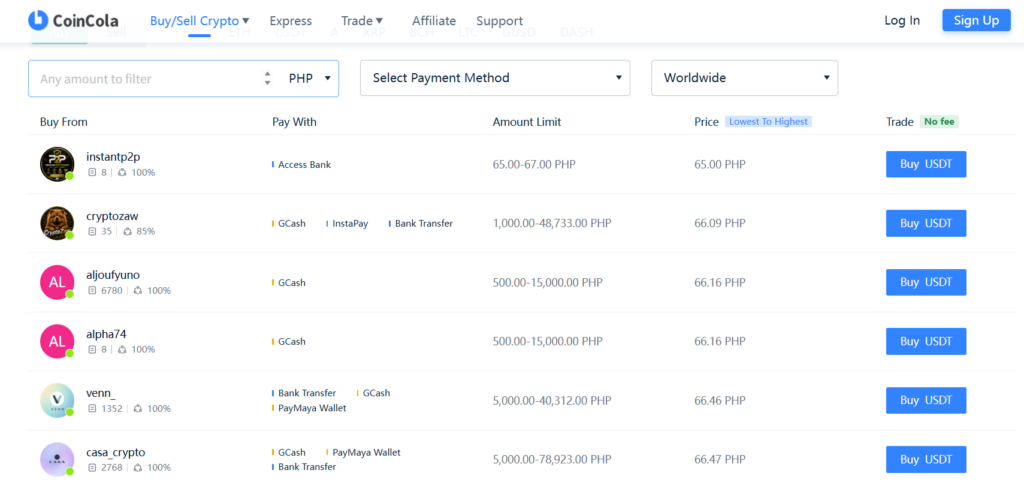
Buying USDT through P2P is relatively simple, but the important part is choosing the right offer rather than simply choosing the cheapest-looking price.
A typical process is:
1. Select USDT and PHP
Choose USDT as the asset you want to buy and PHP as the local currency.
2. Select a payment method
Depending on the marketplace and available advertisers, you may see payment options such as:
- GCash
- Maya / PayMaya Wallet
- Bank Transfer
- Other locally supported payment methods
3. Check the order limit
Suppose an advertisement accepts between ₱1,000 and ₱10,000.
If you want to buy ₱500 worth of USDT, that offer does not work for you — even if its advertised price looks attractive.
4. Check the trader
Look beyond the price.
A trader with a slightly less attractive price but a strong transaction history may be a more practical choice than an unfamiliar account offering an unusually good rate.
5. Follow the payment instructions
Once the order is opened, use the payment route shown inside the P2P order.
Do not move the transaction to a private chat simply because another person promises a better price.
Buying USDT With GCash
GCash is particularly relevant to Philippine P2P trading because it gives users a familiar PHP payment route.
For example, CoinCola currently provides a dedicated USDT/PHP market filtered for GCash offers, allowing users to compare the available price, PHP limits and trader terms before opening an order.
Buy USDT with GCash on CoinCola
The important point is that GCash availability is determined by individual P2P advertisements.
It should not be assumed that every seller accepts GCash.
Before paying, check:
- The advertisement specifically lists GCash.
- Your PHP amount falls within the order limit.
- The asset is USDT, not BTC or another cryptocurrency.
- The seller’s terms are acceptable.
- The payment instructions match the active order.
This is one reason local P2P markets are more practical than simply looking for a single advertised exchange rate.
How Filipinos Sell USDT for PHP
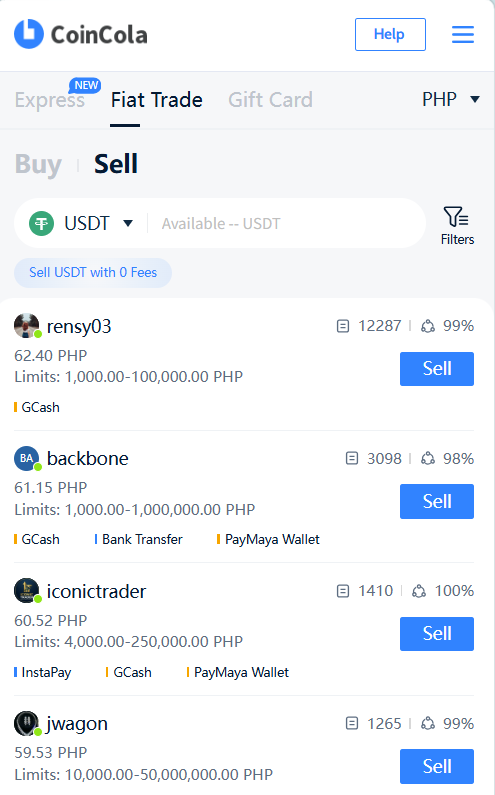
The reverse transaction is equally important.
You already have USDT and want PHP.
The P2P flow becomes:
USDT → P2P buyer → PHP → GCash, Maya or bank account
The process is generally:
1. Choose Sell USDT
Select USDT and PHP as the trading pair.
2. Choose the payout method
Look for buyers who support the payment method you actually want to receive.
For example:
- GCash
- Maya
- Bank Transfer
3. Check the buyer’s limits
If you are selling ₱50,000 worth of USDT, an offer capped at ₱5,000 obviously isn’t useful.
4. Compare the buyer
Check the buyer’s trading history, feedback and terms.
5. Wait for the PHP payment
This is where sellers need to be particularly careful.
Do not release USDT based on a screenshot.
Check your own GCash, Maya or bank account and verify that the money has actually arrived.
Only then should you release the crypto according to the order process.
Selling USDT for GCash
For users who want a straightforward PHP cash-out route, GCash can be one of the most convenient options when suitable P2P buyers are available.
CoinCola’s current USDT/PHP GCash market allows sellers to compare buyers that list GCash, including the PHP price, order limits and trader terms.
Sell USDT for GCash on CoinCola
The key word here is current.
P2P offers are created by individual advertisers. Prices, limits and payment methods can change as traders update or remove their advertisements.
So an article can explain the process, but the live P2P market should always be treated as the source of truth for the actual trade.
What About Maya?
Maya is another important payment route for Philippine users.
One small detail can cause confusion: some P2P marketplaces may still display PayMaya Wallet as the payment-method label even though the consumer-facing brand is now Maya.
CoinCola’s current Maya route explains this distinction and advises sellers to verify the actual payment in their own account before releasing USDT.
Sell USDT for Maya on CoinCola
Again, the practical rule is simple:
Don’t choose a payment method because it appears somewhere on a general list. Choose an active P2P offer that explicitly supports the payment route you intend to use.
Why P2P Prices Can Be Different From the “Market Price”
New P2P users sometimes expect USDT to have one fixed PHP price.
It doesn’t.
Imagine you see three offers:
| Seller | Price per USDT | Limit | Payment |
|---|---|---|---|
| Trader A | ₱78.50 | ₱500–₱5,000 | GCash |
| Trader B | ₱79.00 | ₱1,000–₱20,000 | GCash |
| Trader C | ₱79.40 | ₱10,000–₱100,000 | Bank Transfer |
The cheapest offer isn’t automatically the best offer.
Trader A may have a low maximum limit.
Trader B may fit your amount better.
Trader C may be preferable if you need a larger bank transfer.
This is the fundamental difference between P2P and a simple currency converter.
You are choosing a trade, not just a price.
How to Choose a P2P Trader
Price should be only one part of the decision.
A more useful checklist is:
Trader history
Look at completed transactions and feedback.
A long transaction history can provide more context than a very attractive price from an account with little trading history.
Order limits
Make sure your actual amount falls comfortably inside the advertised range.
Payment method
The payment method needs to work for you, not just exist on the platform.
Trading terms
Read the advertiser’s conditions before starting.
Some traders may have specific requirements regarding payment names, transaction amounts or timing.
Completion record
A trader’s historical performance can help you assess reliability, although past activity is not a guarantee of future performance.
Price
Only compare price after the other factors make the offer usable.
Is P2P Crypto Trading Safe in the Philippines?
P2P is not automatically safe simply because a platform has an escrow system.
There are several different risks involved.
1. Counterparty risk
You are interacting with another trader.
That means you should evaluate the trader and follow the marketplace’s transaction process.
2. Payment risk
A screenshot saying “payment sent” is not proof that your money has arrived.
Always verify the receiving account yourself.
3. Platform risk
The marketplace itself matters.
The closure of NoOnes is a useful reminder that users should not treat any crypto platform as permanent. NoOnes’ own wind-down notice specifically advised users to withdraw remaining funds and warned that external providers might apply additional review to transactions connected to its wallets.
4. Regulatory risk
The regulatory environment also matters.
The Bangko Sentral ng Pilipinas (BSP) maintains a directory of registered virtual asset service providers and provides a verification tool for financial institutions, including VASPs.
In January 2026, BSP also reminded supervised financial institutions to conduct appropriate due diligence when dealing with VASPs and other crypto-asset service providers, including verifying registration or authorization where applicable.
That does not mean every platform available to a Filipino user is BSP-regulated.
It means users should check the regulatory status that actually applies to the platform and service they are using, rather than assuming that an app, website or P2P marketplace is locally licensed.
This distinction is important.
What the Philippine Regulatory Environment Means for Crypto Users
The Philippines has a formal regulatory framework around virtual asset services, but crypto users still need to understand what that framework does — and does not — tell them.
BSP’s guidance increasingly emphasizes risk management, due diligence, consumer protection and financial integrity.
For example, its June 2026 token-listing guidelines tell VASPs to consider factors including:
- issuer background
- market maturity
- use cases
- transparency and traceability
- security
- liquidity and reserves
- legal and compliance considerations
For ordinary P2P users, the broader lesson is straightforward:
Don’t evaluate a crypto service only by its advertised price.
Look at the platform, the transaction mechanism, the counterparty, the payment route and the applicable regulatory environment.
Why Filipino Users Continue to Need P2P
The disappearance of one platform does not eliminate the demand for P2P.
The use cases are much broader.
Freelancers
A freelancer may receive USDT from an international client and eventually need PHP for everyday expenses.
Remote workers
Someone working for a foreign company may prefer receiving part of their compensation in stablecoins and converting it when needed.
Crypto traders
A trader may want to move between USDT and PHP without using the same route every time.
Family transfers
Someone receiving crypto from overseas may eventually need to convert it into local currency.
Everyday cash-out
A user may simply have USDT and want pesos in a GCash, Maya or bank account.
These are not really “NoOnes use cases.”
They are Philippine crypto use cases.
That is why the market continues even when individual platforms change.
Where CoinCola Fits Into the Philippine P2P Market
For Filipino users, the useful question is not simply:
“What replaced NoOnes?”
A better question is:
“Where can I currently access the P2P market I actually need?”
CoinCola provides PHP-denominated P2P markets for users looking to buy or sell crypto.
For USDT, users can access the PHP market and compare available advertisements based on price, limits and payment methods. CoinCola’s current PHP USDT market shows advertisers offering methods including GCash and bank transfer.
For users specifically looking to sell USDT, CoinCola also provides PHP buyer listings, including payment routes such as GCash and Maya where available.
The advantage of this approach is not that CoinCola promises one fixed PHP rate.
It doesn’t.
The marketplace lets users compare the offers that are actually available at the time they want to trade.
How CoinCola’s P2P Escrow Works
One of the most important concepts for anyone new to P2P is escrow.
In a typical P2P order, the seller’s crypto is placed into escrow while the buyer completes the payment.
CoinCola explains its process as:
- Choose an offer.
- Follow the payment instructions.
- Complete the payment.
- The crypto is released after the transaction is confirmed.
If a dispute occurs, the crypto remains in escrow while the issue is reviewed.
This is different from simply finding someone on Telegram, Facebook or WhatsApp and sending crypto directly to them.
The marketplace creates a transaction record and keeps the crypto within the P2P order process.
That does not eliminate every risk, but it gives both sides a defined process to follow.
A Simple Example: Cashing Out USDT in the Philippines
Suppose you have 1,000 USDT and want PHP.
You could approach the transaction like this:
Step 1 — Select USDT/PHP
Find buyers who are currently purchasing USDT for PHP.
Step 2 — Filter by payment method
If you want GCash, look specifically for buyers that list GCash.
Step 3 — Check the limit
Make sure the buyer accepts your intended transaction size.
Step 4 — Compare traders
Look at price, transaction history, feedback and terms.
Step 5 — Open the order
Follow the instructions inside the P2P order.
Step 6 — Verify PHP
Check your actual GCash account and confirm the payment has arrived.
Step 7 — Release USDT
Only release the crypto after you have independently confirmed receipt of the PHP payment.
The same basic logic applies when using Maya or another supported payment route.
The Biggest Mistakes New P2P Users Make
Most problems don’t come from the basic mechanics of P2P.
They come from skipping small checks.
Choosing the cheapest offer without reading the terms
The cheapest price may have a small limit or conditions that don’t fit your transaction.
Releasing crypto based on a screenshot
Never treat a screenshot as proof of payment.
Moving the conversation outside the platform
If the transaction is supposed to happen inside a P2P order, keep it there.
Ignoring order limits
An offer isn’t useful if your amount doesn’t fit its minimum or maximum.
Assuming every payment method is always available
P2P advertisers can add or remove payment methods.
Sending crypto to the wrong network
If you later transfer USDT to another wallet or exchange, check the receiving platform’s supported network first.
This is a separate transaction from the P2P trade and should be treated accordingly.
P2P Crypto in the Philippines: What to Look for in 2026
If you are comparing P2P offers in the Philippines, price is only one part of the decision.
Users have more ways to move between crypto and PHP, but that also means comparing platforms purely on headline price makes less sense.
A better framework is:
| Factor | What to look for |
|---|---|
| PHP liquidity | Enough offers for your transaction size |
| Payment methods | GCash, Maya, bank transfer or another method you actually use |
| Trader quality | Transaction history and feedback |
| Order limits | Limits that match your amount |
| Escrow | Crypto held during the transaction |
| Platform controls | Clear order and dispute processes |
| Regulatory awareness | Verify the applicable registration or authorization |
| Transparency | Clear pricing, terms and transaction status |
The strongest P2P experience is usually not the one with the single lowest advertised price.
It is the one where the price, payment method, limit, trader and transaction process all fit together.
Final Thoughts
The closure of NoOnes changed the options available to some crypto users, but it did not change the fundamental demand for P2P trading in the Philippines.
Filipinos still need practical ways to:
- Buy USDT with PHP
- Sell USDT for PHP
- Use GCash
- Use Maya
- Receive or send crypto
- Convert digital assets into local currency
The important part is choosing a marketplace carefully and treating each P2P trade as a financial transaction rather than a casual crypto transfer.
Check the trader.
Check the limits.
Check the payment method.
Keep the transaction inside the platform.
And when selling crypto, verify that the PHP has actually arrived before releasing your USDT.
For users looking specifically for USDT/PHP markets, CoinCola provides live P2P offers that can be compared by price, payment method and order limits. Availability changes with individual advertisements, so the live market — rather than a static article — should always be checked before starting a trade.
The platform may change. The need to move between crypto and PHP remains.