NoOnes Alternative: What the EU’s New Sanctions Mean for Crypto Users in 2026
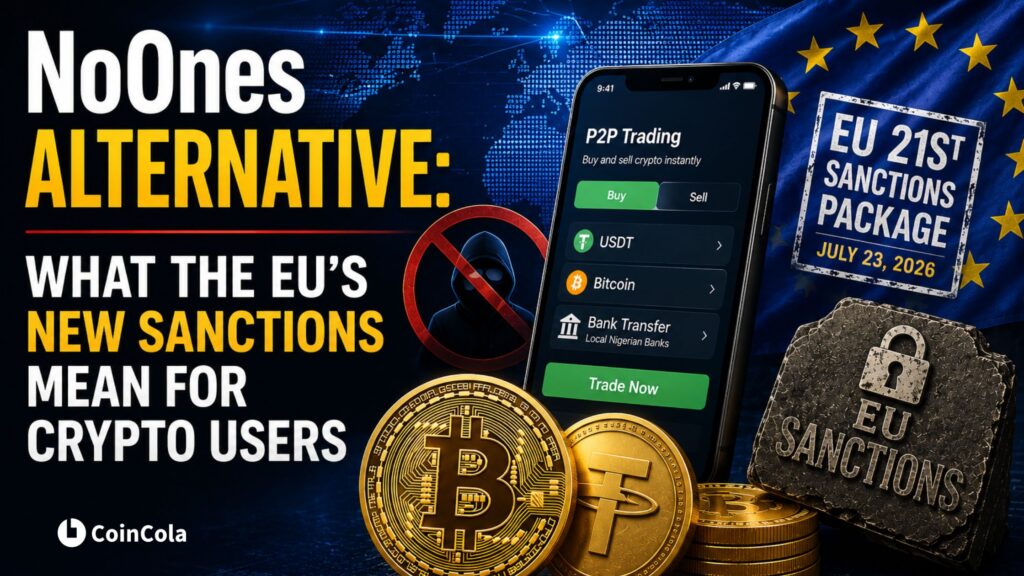
Peer-to-peer crypto exchange NoOnes has officially announced its wind-down process, halting P2P trading on August 21, 2026, and moving into withdrawal-only mode. If you are searching for a reliable, secure, and liquidity-rich NoOnes alternative, CoinCola is your answer. As a trusted global crypto platform, CoinCola offers competitive fees, robust multi-currency support, and escrow-protected trading to keep your peer-to-peer operations running smoothly.
On 23 July 2026, the European Union adopted its 21st sanctions package against Russia, introducing one of the most significant expansions of crypto-related sanctions in recent years. As part of the package, the EU imposed transaction bans on 14 crypto service providers, including NoOnes, alleging that these platforms had been used to facilitate sanctions evasion.
The announcement immediately raised questions across the cryptocurrency community, especially among users in Africa where NoOnes has built a strong presence. Thousands of traders are now asking:
- Is NoOnes banned?
- Can Nigerians still use NoOnes?
- Will my funds be affected?
- Should I switch to another P2P exchange?
- What is the best NoOnes alternative?
The short answer is that the EU sanctions do not automatically prohibit Nigerian residents from using NoOnes under Nigerian law. However, international sanctions often have broader business implications. They can affect banking relationships, liquidity providers, payment partners, and the willingness of institutional counterparties to work with a platform. Over time, these indirect effects may influence the overall user experience, particularly for cross-border transactions.
For anyone actively buying or selling cryptocurrency through peer-to-peer (P2P) marketplaces, this is also a timely reminder that platform selection should be based on more than just trading volume. Security, escrow protection, regulatory compliance, customer support, and long-term platform stability are becoming increasingly important considerations.
In this guide, we’ll explain:
- What happened to NoOnes
- Why the EU imposed sanctions
- Whether Nigerian users should be concerned
- How to evaluate a trustworthy P2P exchange
- Why many traders are exploring alternatives such as CoinCola
- How to migrate safely if you decide to change platforms
Whether you’re an experienced crypto trader or someone who simply wants a reliable way to sell USDT in Nigeria, this guide will help you understand the latest developments and make a more informed decision.
What Happened to NoOnes?
On 23 July 2026, the Council of the European Union adopted its 21st package of restrictive measures against Russia, marking the largest sanctions package in nearly four years. The package introduced 218 new designations targeting financial institutions, logistics companies, military suppliers, and cryptocurrency service providers that European authorities believe have played a role in helping Russia circumvent existing sanctions.
Among the measures announced was a transaction ban on 14 crypto-related platforms operating across several jurisdictions, including:
- Georgia
- Panama
- United Arab Emirates
- Marshall Islands
- Kyrgyzstan
- Belarus
The designated crypto entities include:
- NoOnecrypto INC.
- BitPapa
- HTX (HUOBI GLOBAL SA)
- WhiteBird
- Rapira
- EXMO Ltd
- ABCeX (Nueva Cryptologia S.A.S DE C.V.)
- Tradex (Brightum LLC)
- A7 Nigeria
- A7 Africa
- and several others.
According to the European Council, these platforms allegedly enabled Russian entities to move digital assets in ways that circumvented existing sanctions.
As a result, EU persons and entities are prohibited from conducting transactions with these designated platforms under the new sanctions package.
It’s important to understand what this announcement does not mean.
The sanctions do not automatically freeze user assets, nor do they constitute a worldwide ban on NoOnes. Instead, they prohibit transactions involving EU persons and organizations, while potentially increasing compliance expectations for financial institutions and service providers that interact with these platforms.
This distinction is important because headlines circulating on social media often oversimplify sanctions announcements, leading some users to believe that a platform has been shut down globally when that is not necessarily the case.
Why Did the EU Sanction NoOnes?
The EU’s latest sanctions package reflects a broader shift in how regulators view cryptocurrency platforms.
In previous sanctions packages, regulators primarily targeted individuals, wallets, or specific financial institutions. The latest package goes a step further by directly targeting crypto service providers that authorities believe have facilitated sanctions evasion.
According to the European Council and Chainalysis analysis, the objective is not simply to restrict specific wallets but to prevent entire platforms from becoming channels through which sanctioned entities can move value internationally.
This development highlights a growing expectation that cryptocurrency platforms should implement robust compliance measures, including:
- Customer identity verification (KYC)
- Sanctions screening
- Transaction monitoring
- Risk-based compliance controls
- Suspicious activity detection
- Enhanced due diligence for higher-risk users
These expectations are increasingly consistent with global regulatory standards rather than being unique to the European Union.
For users, this means that compliance has become an important factor when choosing where to trade digital assets. A platform’s ability to maintain relationships with banking partners, payment providers, and liquidity providers may increasingly depend on the strength of its compliance program.
What Is the EU’s New Third-Country Ban Mechanism?
One of the most significant—but less discussed—changes introduced in the 21st sanctions package is the creation of a third-country ban mechanism for crypto-asset services.
Previously, EU sanctions generally targeted specific companies or individuals. Under the new framework, the EU now has the legal authority to impose broader restrictions on crypto service providers operating within an entire jurisdiction if regulators conclude that those providers are being used to facilitate sanctions evasion.
This mechanism has not yet been applied to any country as of the time of writing. However, its introduction signals a stronger regulatory approach toward international crypto compliance.
For crypto businesses, the implications are significant.
Platforms operating outside the EU may face increased scrutiny if they:
- Maintain weak sanctions controls
- Have limited customer verification procedures
- Operate in jurisdictions considered high risk
- Fail to monitor suspicious transactions
- Have inadequate compliance resources
Although these rules primarily affect institutional relationships rather than everyday retail traders, they reinforce a broader trend: compliance is becoming a competitive advantage in the cryptocurrency industry.
For users, choosing a platform with transparent operations, strong security practices, and established compliance procedures may help reduce uncertainty as global regulations continue to evolve.
Does This Affect Nigerian Users?
This is the question most Nigerian traders are asking.
The answer requires separating legal restrictions from practical business impacts.
From a legal perspective
The EU sanctions package applies to:
- EU citizens
- EU companies
- Organizations operating within the European Union
- Transactions that fall under EU jurisdiction
The sanctions do not automatically prohibit Nigerian residents from using NoOnes under Nigerian law.
If you live in Nigeria and use NoOnes exclusively within the framework of Nigerian regulations, the EU sanctions do not directly create new legal obligations for you.
However, international sanctions can still create indirect consequences that affect users worldwide.
From a practical perspective
Even when sanctions apply only to specific jurisdictions, they can influence how a platform operates globally.
For example, a sanctioned platform may experience:
- More stringent banking compliance reviews
- Changes in payment processing partners
- Increased operational costs
- Reduced institutional liquidity
- Additional due diligence from counterparties
- Regional service adjustments over time
These outcomes are not unique to NoOnes. Similar patterns have been observed across the financial industry whenever major institutions become subject to international sanctions or enhanced regulatory scrutiny.
For everyday Nigerian traders, the most important question is therefore not simply “Can I still use NoOnes?”, but rather:
“Is this the platform I want to rely on for my long-term crypto trading needs?”
As the cryptocurrency industry matures, many users are choosing platforms that combine strong security, reliable customer support, transparent operations, and a long-term commitment to compliance.
If you’re considering exploring other options, our guide on P2P crypto trading explains how escrow protection works and what to look for in a reliable marketplace. You can also learn how to sell USDT in Nigeria safely before comparing platforms. Finally, if you’re ready to evaluate another marketplace, visit the NoOnes Alternative page to see how CoinCola supports Nigerian P2P traders with escrow protection, local payment methods, and verified merchants.
How to Choose the Best NoOnes Alternative
If you’re considering moving away from NoOnes, it’s worth taking a step back before opening an account elsewhere. Not every P2P exchange offers the same level of security, liquidity, or user experience.
Many traders make the mistake of choosing a platform based solely on the number of listed offers or the lowest advertised price. In reality, a reliable P2P marketplace should provide a balance of security, convenience, transparency, and long-term stability.
Here are the most important factors to consider.
1. Strong Escrow Protection
Escrow is one of the biggest reasons why P2P crypto trading has become so popular.
Instead of sending cryptocurrency directly to the buyer, the platform temporarily locks the seller’s crypto in escrow. Once payment is confirmed, the crypto is released automatically to the buyer.
This process protects both parties:
For buyers
- The seller cannot disappear after receiving payment.
- Crypto remains locked until payment is completed.
For sellers
- Buyers cannot falsely claim payment while receiving crypto.
- The platform can review evidence during disputes.
Without escrow, P2P trading would require users to trust complete strangers.
If you’re new to this process, read our guide on P2P Crypto Trading to understand how escrow protects every transaction.
2. High Liquidity
Liquidity determines how quickly your orders are filled.
For example, imagine you want to sell 500 USDT.
On a marketplace with many active merchants, you may complete the trade in just a few minutes.
On a marketplace with fewer buyers, you may wait significantly longer or accept a less favorable exchange rate.
Healthy liquidity generally means:
- More competing merchants
- Better prices
- Faster order completion
- Larger trading limits
- Lower spreads
This becomes especially important if you regularly buy or sell large amounts of USDT.
3. Local Nigerian Payment Methods
One reason P2P trading has become extremely popular in Nigeria is the ability to trade directly using local bank transfers.
A good platform should support payments through Nigerian banks so users can quickly exchange crypto for Naira.
For many traders, the goal isn’t simply buying cryptocurrency—it’s converting digital assets into spendable cash.
If that’s your objective, check out our guide on How to Sell USDT in Nigeria, which explains the complete process from wallet transfer to receiving Naira in your bank account.
4. Verified Merchants
Not every P2P trader has the same level of experience.
Most reputable platforms identify merchants who consistently maintain:
- High completion rates
- Positive customer feedback
- Fast response times
- Large trading volumes
- Reliable payment records
Trading with verified merchants generally reduces risk and creates a smoother experience.
When comparing different P2P exchanges, always look beyond price alone.
5. Responsive Customer Support
Even experienced traders occasionally encounter issues such as:
- Payment delays
- Incorrect transfer references
- Bank verification questions
- Disputes between buyers and sellers
When these situations occur, fast customer support becomes extremely valuable.
A platform with an active dispute resolution process can often resolve problems much faster than users attempting to negotiate privately.
6. Security Features
Cryptocurrency security goes far beyond passwords.
Look for exchanges that provide:
- Two-factor authentication (2FA)
- Login notifications
- Withdrawal confirmation
- Anti-phishing codes
- Device management
- Risk monitoring
Protecting your account should always be a priority regardless of which exchange you choose.
7. Compliance and Transparency
The crypto industry has changed dramatically over the past few years.
Today, users increasingly evaluate exchanges based on factors such as:
- Regulatory transparency
- AML controls
- KYC procedures
- Risk management
- Public communication
A platform that invests in compliance is often better positioned to maintain long-term relationships with payment providers and financial institutions.
Best NoOnes Alternatives in 2026
If you’re researching alternatives, you’ll quickly discover dozens of P2P exchanges online.
Each platform serves different types of users, depending on trading volume, supported countries, payment methods, and available cryptocurrencies.
Below are some of the most recognized options.
CoinCola
CoinCola has focused on P2P cryptocurrency trading for years and remains particularly popular among users looking to trade with local payment methods.
Key features include:
- Escrow-protected trading
- Buy and sell USDT
- Buy and sell Bitcoin
- Nigerian bank transfers
- Verified merchants
- Competitive fees
- Mobile-friendly trading
Unlike many global exchanges that primarily focus on spot trading, CoinCola continues investing in improving the P2P experience for users in emerging markets.
If you’re specifically looking for a NoOnes alternative, CoinCola offers a dedicated resource explaining how the platform compares and how to get started.
👉 Explore the NoOnes Alternative page
Binance P2P
Binance remains one of the world’s largest cryptocurrency exchanges and offers a mature P2P marketplace.
Advantages include:
- Large liquidity
- Multiple cryptocurrencies
- Wide payment support
Potential considerations:
- Interface may feel complex for beginners.
- Focus extends beyond P2P trading.
Bybit P2P
Bybit has expanded its P2P marketplace significantly over recent years.
Highlights include:
- Competitive merchant network
- User-friendly mobile application
- Multiple supported payment methods
OKX P2P
OKX offers P2P trading alongside its broader exchange ecosystem.
Users may appreciate:
- Strong trading infrastructure
- Large cryptocurrency selection
- Integrated wallet services
Which Platform Is Best?
There is no single “best” exchange for every trader.
Instead, ask yourself:
- Do I mainly trade USDT?
- Do I need Nigerian bank transfers?
- How important is customer support?
- How often do I trade?
- Do I value simplicity or advanced trading tools?
Your answers will help determine which platform best matches your needs.
Why More Nigerian Traders Are Choosing CoinCola
Nigeria remains one of Africa’s most active cryptocurrency markets.
Millions of users rely on digital assets for purposes including:
- Savings
- International payments
- Business settlements
- Freelance income
- Family remittances
- Investment
Because of this, Nigerian traders often have different priorities compared with users in Europe or North America.
CoinCola has continued developing features that address these practical needs.
Fast P2P Trading
Rather than waiting for complicated exchange processes, users can trade directly with verified merchants.
Many completed trades finish within minutes after payment confirmation.
Escrow Protection
Every P2P order benefits from escrow protection.
Neither party needs to rely solely on trust.
The platform temporarily secures the cryptocurrency until payment conditions have been satisfied.
Local Payment Support
CoinCola supports payment methods commonly used by Nigerian traders.
This makes it easier to:
- Buy USDT
- Sell USDT
- Buy Bitcoin
- Receive Naira directly into local bank accounts
For users sending funds home, you may also find our guide on How to Send Money to Nigeria with Crypto helpful, as it explains how stablecoins can simplify international transfers while reducing costs compared with many traditional remittance methods.
Verified Merchant Network
A healthy merchant ecosystem creates:
- Better pricing
- Faster responses
- Larger order limits
- Improved trading experience
Users can review merchant statistics before accepting an offer.
Built for Everyday Users
Not every crypto trader is a professional.
Some simply want to:
- Convert USDT into Naira
- Buy Bitcoin occasionally
- Receive overseas payments
- Send money to family members
CoinCola’s interface is designed to keep these everyday transactions straightforward.
Continuous Security Improvements
Security remains a long-term investment rather than a one-time feature.
CoinCola continues enhancing:
- Risk controls
- Fraud detection
- User verification
- Account protection
- Platform monitoring
These improvements help provide a safer trading environment for the community.
CoinCola vs NoOnes
The comparison below is intended to help users evaluate the platforms based on publicly available information and their own trading needs.
| Feature | CoinCola | NoOnes |
|---|---|---|
| P2P Trading | ✅ | ✅ |
| Escrow Protection | ✅ | ✅ |
| Buy & Sell USDT | ✅ | ✅ |
| Buy & Sell Bitcoin | ✅ | ✅ |
| Nigerian Bank Payments | ✅ | ✅ |
| Verified Merchants | ✅ | ✅ |
| Mobile Trading | ✅ | ✅ |
| Customer Support | Dedicated support | Available |
| Fiat Payment Options | Multiple | Multiple |
| Trading Interface | Beginner-friendly | Beginner-friendly |
| Security Features | 2FA, risk controls | Platform security features |
| Merchant Ratings | ✅ | ✅ |
| Dispute Resolution | ✅ | ✅ |
| Compliance Focus | Ongoing investment in compliance and risk management | Subject to the EU’s July 2026 sanctions designation |
| Best For | Users seeking a secure P2P marketplace with strong Nigerian support | Existing users familiar with the platform |
It’s important to note that every trader’s priorities are different. Some users focus on liquidity, while others value customer support, payment flexibility, or ease of use. The best platform is ultimately the one that aligns with your trading habits, preferred payment methods, and risk tolerance.
Ready to switch?
Explore our NoOnes Alternative page.
Want to understand how P2P trading compares with traditional international bank transfers? Read:SWIFT vs Blockchain: Which Is Faster and Cheaper for International Transfers?
How to Move from NoOnes to CoinCola
If you’ve decided to explore another P2P marketplace, switching platforms is a straightforward process. The key is to move your assets securely and become familiar with the new trading environment before making large transactions.
The following steps can help ensure a smooth transition.
Step 1: Create Your CoinCola Account
Visit the official CoinCola website and register using your email address or mobile number.
Choose a strong password and immediately enable Two-Factor Authentication (2FA) to add an extra layer of account security.
Before making any deposits, verify that you’re visiting the official CoinCola domain to avoid phishing websites.
Step 2: Complete Identity Verification
Most reputable cryptocurrency exchanges require identity verification (KYC) to comply with anti-money laundering regulations and improve platform security.
Completing verification may also unlock:
- Higher trading limits
- Faster dispute resolution
- Better account protection
- Access to additional services
Providing accurate information during registration can help avoid delays later.
Step 3: Transfer Your Cryptocurrency
If your crypto assets are stored in your NoOnes wallet, you can transfer them to your CoinCola wallet by generating a deposit address for the corresponding cryptocurrency.
Before confirming any transfer:
- Double-check the wallet address.
- Confirm the blockchain network.
- Send a small test transaction if you’re transferring a large amount.
- Wait for blockchain confirmations before initiating a trade.
Taking a few extra minutes to verify these details can prevent costly mistakes.
Step 4: Explore the P2P Marketplace
Before placing your first order, spend some time reviewing the available offers.
Look for merchants with:
- High completion rates
- Large numbers of completed trades
- Positive user feedback
- Quick response times
- Competitive pricing
Choosing experienced merchants often leads to smoother transactions.
Step 5: Complete Your First Trade
Once you’ve selected a suitable offer:
- Open the trade.
- Follow the payment instructions carefully.
- Complete the bank transfer using your own account.
- Upload proof of payment if requested.
- Wait for the seller to confirm receipt.
- Ensure the cryptocurrency has been released from escrow before leaving the trade.
Never mark a payment as completed unless you have actually sent the funds.
Likewise, sellers should never release cryptocurrency until payment has been confirmed in their own bank account.
Step 6: Learn the Platform’s Features
Many users only use a small portion of what a P2P exchange offers.
Take some time to explore:
- Favorite merchants
- Trading history
- Security settings
- Notification preferences
- Referral program (if available)
- Educational resources
The more familiar you become with the platform, the more efficiently you’ll be able to trade.
Common Mistakes to Avoid When Switching Exchanges
Changing platforms is generally simple, but many new users make avoidable mistakes.
Here are some of the most common ones.
Choosing the Lowest Price Without Checking the Merchant
The cheapest offer isn’t always the best one.
Always review:
- Completion rate
- Number of completed orders
- Merchant verification
- Response time
- Customer reviews
A slightly higher price is often worth paying for a smoother transaction.
Releasing Crypto Too Early
This remains one of the most common causes of P2P fraud.
As a seller, never release cryptocurrency simply because the buyer sends a payment screenshot.
Always verify that the funds have arrived in your own bank account before confirming the release.
Ignoring Platform Security
Many account compromises happen because users neglect basic security measures.
Protect yourself by:
- Enabling 2FA
- Using a unique password
- Avoiding public Wi-Fi for sensitive transactions
- Watching for phishing emails or fake websites
- Keeping your devices updated
Security starts with the user.
Trading Outside the Platform
Occasionally, someone may ask you to continue the transaction through WhatsApp, Telegram, or another messaging app.
Avoid doing so.
Keeping communication and payments within the platform makes it easier to resolve disputes if something goes wrong.
Skipping the Platform Rules
Every P2P exchange has its own policies regarding:
- Payment methods
- Identity verification
- Dispute resolution
- Order cancellation
- Merchant requirements
Reading these guidelines beforehand can save time and prevent unnecessary issues.
Frequently Asked Questions
NoOnes has been included in the European Union’s 21st sanctions package, which prohibits EU persons and entities from conducting transactions with the platform. This is not a worldwide ban.
According to the European Council, NoOnes was designated because authorities alleged that it was among several crypto platforms used to facilitate sanctions evasion involving Russia.
The EU sanctions do not automatically prohibit Nigerian residents from using NoOnes under Nigerian law. However, international sanctions may indirectly affect banking relationships, liquidity, payment partnerships, or other aspects of platform operations over time.
The EU sanctions package does not automatically freeze user-held cryptocurrency on NoOnes. If you have concerns about any exchange, consider reviewing your security practices, diversifying storage methods, and staying informed through official platform announcements.
Yes. CoinCola supports buying and selling Bitcoin through its P2P marketplace using supported local payment methods. If you’re new to cryptocurrency, our Buy Bitcoin in Nigeria guide explains the process step by step.
Should I move to another exchange?
Every user has different priorities.
You may wish to compare factors such as:
- Security
- Customer support
- Escrow protection
- Trading fees
- Payment methods
- Merchant quality
- Platform stability
Choosing the right exchange depends on your individual trading needs.
Why are more traders comparing CoinCola with NoOnes?
Many users searching for alternatives are looking for:
- Secure escrow protection
- Reliable P2P trading
- Local Nigerian payment methods
- Verified merchants
- Responsive customer support
- Long-term platform reliability
These are areas that traders commonly evaluate when choosing a P2P marketplace.
Can I sell USDT for Nigerian Naira?
Yes.
CoinCola allows eligible users to sell USDT directly to verified P2P merchants and receive payment through supported Nigerian bank transfer methods.
For a complete walkthrough, see our guide on How to Sell USDT in Nigeria.
How long does a P2P trade usually take?
Most completed trades are finalized within 10–30 minutes, although the exact time depends on:
- Payment method
- Merchant response time
- Banking hours
- Transaction confirmation
What should I do if there’s a dispute?
If a disagreement occurs during a trade, use the platform’s official dispute resolution process.
Provide all requested evidence, including payment receipts and communication records, and wait for the platform’s support team to review the case.
Avoid resolving disputes outside the platform.
Final Thoughts
The European Union’s latest sanctions package highlights an important trend in the cryptocurrency industry: compliance and trust are becoming just as important as price and liquidity.
For Nigerian users, the sanctions on NoOnes do not automatically create new legal restrictions. However, they do remind traders that the long-term reliability of a platform depends on more than trading volume alone.
When choosing a P2P exchange, consider the complete picture:
- Security
- Escrow protection
- Merchant quality
- Customer support
- Local payment options
- Platform transparency
- Commitment to compliance
A platform that performs well across all of these areas is more likely to provide a consistent trading experience over the long term.
If you’re exploring alternatives to NoOnes, CoinCola offers a secure P2P marketplace built with Nigerian users in mind. Whether you want to buy Bitcoin, sell USDT, or send money to family members using cryptocurrency, CoinCola combines escrow protection, verified merchants, and local payment support in one platform.
Ready to Explore a NoOnes Alternative?
If you’re looking for a secure and user-friendly P2P crypto marketplace, start here:
👉 Compare CoinCola and explore the NoOnes Alternative page.
You may also find these guides helpful:
- P2P Crypto Trading Guide – Learn how escrow works and how to trade safely.
- How to Sell USDT in Nigeria – A step-by-step guide for converting USDT to Naira.
- Buy Bitcoin in Nigeria – Everything beginners need to know.
- How to Send Money to Nigeria with Crypto – Learn how stablecoins can simplify international transfers.
Disclaimer
This article is provided for informational purposes only and should not be interpreted as legal, financial, investment, or tax advice.
The discussion of the European Union’s sanctions package is based on publicly available information at the time of writing. References to NoOnes and other platforms are included solely to explain recent regulatory developments and to help readers understand factors they may wish to consider when evaluating cryptocurrency exchanges.
Users should conduct their own research, comply with all applicable laws and regulations in their jurisdiction, and consult qualified legal or financial professionals before making decisions related to cryptocurrency trading or platform selection.
Related Articles
- Bitcoin P2P in the Philippines: How to Buy and Sell BTC With PHP
- P2P Crypto in the Philippines: How Filipinos Buy, Sell and Cash Out USDT in 2026
- No KYC Crypto: Is It Really Safe? KYC, AML and P2P Security Explained
- NoOnes Funds Rejected? What to Do If Your Crypto Deposit Is Returned
- How to Buy Bitcoin in Nigeria: Step-by-Step Guide for Beginners